
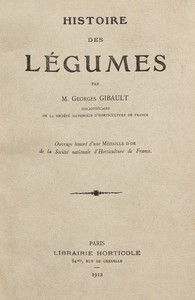
Histoire des légumes by Georges Gibault
The Story
This isn't a story with a single plot, but hundreds of tiny ones. Georges Gibault, writing in the early 1900s, acts as a detective tracing the life stories of common vegetables. He starts with their wild ancestors, follows their paths across continents (often through war, trade, or accident), and shows how they slowly won a place in our gardens and kitchens. The book is organized by plant family, so you get the epic saga of the cabbage clan alongside the dramatic arrival of the tomato in Europe, where it was once feared as a 'love apple' and thought to be poisonous.
Why You Should Read It
I loved this because it makes history feel alive and delicious. Gibault's passion is obvious. He isn't just listing dates; he's telling you why the pea was a luxury in medieval France or how the humble beetroot saved people from starvation. You realize that every vegetable in your fridge has survived centuries of human drama. It’s a humbling and fascinating perspective. Reading it, I kept stopping to share facts with anyone nearby—'Did you know asparagus was a Roman delicacy?'
Final Verdict
This is a treasure for curious minds. It's ideal for food lovers, gardeners, and anyone who enjoys micro-histories that connect to everyday life. The writing is clear and the chapters are short, so it's easy to dip in and out. Just be warned: you'll never look at a plate of veggies the same way again. It’s a classic that reminds us that the most profound histories are often rooted in the soil beneath our feet.
This is a copyright-free edition. Preserving history for future generations.
Kenneth Young
1 year agoGreat digital experience compared to other versions.
Sarah Harris
1 year agoThis book was worth my time since it creates a vivid world that you simply do not want to leave. Highly recommended.
Donna Martin
1 year agoI stumbled upon this title and the narrative structure is incredibly compelling. Truly inspiring.
Paul Anderson
1 year agoIf you enjoy this genre, the arguments are well-supported by credible references. Absolutely essential reading.




Deborah Johnson
1 year agoVery helpful, thanks.