1

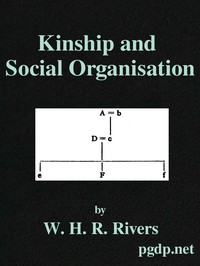
Kinship and Social Organisation — Edition Insights
(0 User reviews)
952
Project Gutenberg
2014
Not confirmed
Marriage; Anthropology; Consanguinity; Ethnology -- Melanesia
Readers of public-domain and historical texts
Project Gutenberg digital edition
en
Edition facts
Words
29,113
Reading time
127 min
Text sections
4
Kinship and Social Organisation — Edition Insights can be approached with a clearer sense of reading commitment from its source measurements: 29,113 words, 2 hr 7 min estimated reading time, and 4 detected text sections.
The text analysis averages about 24.2 words per sentence, while the detected sections provide another way to judge how the source is divided.
Project Gutenberg metadata also associates the work with “Marriage,” connecting these edition facts with the source record’s subject description.
Source:
Project Gutenberg record #44728
Rivers argues that kinship terminology is shaped by social institutions, using Melanesian and Polynesian examples to show how terms like 'brother' extend to in-laws, reflecting marriage regulations and historical sexual norms.
Read the complete public-domain text at its original source.
Read on Project GutenbergRivers opens this series of three lectures by asserting that the terminology of relationship is 'rigorously determined by social conditions,' a claim he supports with evidence from Melanesia and Polynesia. Drawing on his 1908 fieldwork with the Percy Sladen Trust Expedition, he focuses on the classificatory system, where kinship terms apply to whole classes of relatives rather than individuals. The lectures, delivered at the London School of Economics in 1913, aim to demonstrate how marriage forms and other social institutions have moulded these terminologies.
The Classificatory System and Its Critics
Rivers begins by describing the classificatory system, noting that its essential feature is the application of kinship terms to 'classes of relatives which may often be very large.' He acknowledges objections to the term 'classificatory' on the grounds that even English terms apply to classes, but he maintains that the scale and logic differ. The controversy surrounding this system, he says, has 'excited the interest—I might almost say the passions—of sociologists.' Rivers positions his own work as part of a debate about whether kinship terminology reflects social structure or psychological similarity, a point he returns to in later lectures.
Melanesian Evidence: In-Laws and Sexual Regulations
In Lecture III, Rivers examines a specific case: the classification of certain in-laws with siblings in Oceania. He notes that in Merlav, Banks Islands, only the wife's sister and a man's brother's wife are classed with the sister, and the husband's brother and a woman's sister's husband with the brother—while other in-laws have distinct terms. Rivers argues that this pattern cannot be explained by 'psychological similarity' alone, as proposed by Kroeber. Instead, he finds evidence that sexual relations were formerly allowed between a man and his wife's sisters or brothers' wives, and that classing these relatives with siblings served to emphasize the 'impropriety' of such relations after they ceased.
Method and Scope of the Lectures
Rivers frames his lectures as a 'simplified record' of social conditions that will be detailed in the full expedition report. He acknowledges contributions from Westermarck and Malinowski in discussions, and cites unpublished material from Miss B. Freire-Marreco on Pueblo Indians. The lectures are based on fieldwork, not armchair theory, and Rivers is careful to limit his claims: he says he has 'only scratched the surface covering a rich mine of knowledge.' The text includes an index and is part of a monograph series from the London School of Economics.
Readers should note that Rivers’ argument is built on specific ethnographic cases, not universal claims. The excerpts show him engaging with contemporaries like Kroeber, but the full lectures may develop additional lines of evidence. The book is best approached as a focused argument about kinship terminology as a tool for studying social history, grounded in Melanesian data.
Sometimes I think about how Rivers traces a single word like "brother" through marriage rules, and it stays with me, the way certain quiet passages from Pedagogical Anthropology — Reading Notes lingered after I'd closed it. Both feel less like facts and more like slowly unfolding recognitions of how we're shaped without noticing.
There are no reviews for this eBook.
There are no comments for this eBook.
Reader reflection
Take a moment to reflect on this book
Create a short personal record of your experience with this book.
Your progress
0
/
10
2
Did this book hold your interest?
3
Would you pass this book on to a friend?
4
How easy was the book to follow?
5
How well did it match your expectations?
6
What did you think about the pace?
7
Would you read this book again?
8
Which aspect of the book did you value most?
9
In one sentence, what did you learn?
10