1

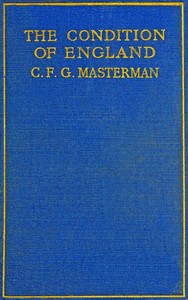
The condition of England — A Closer Reading
(0 User reviews)
423
Project Gutenberg
2023
Not confirmed
Great Britain -- Social conditions; Great Britain -- Economic conditions
Readers of public-domain and historical texts
Project Gutenberg digital edition
en
Edition facts
Words
85,093
Reading time
370 min
Text sections
20
The source record for The condition of England — A Closer Reading measures this digital text at 85,093 words, 6 hr 10 min estimated reading time, and 20 detected text sections.
The text analysis averages about 25.1 words per sentence, while the detected sections provide another way to judge how the source is divided.
Project Gutenberg metadata also associates the work with “Great Britain -- Social conditions,” connecting these edition facts with the source record’s subject description.
Source:
Project Gutenberg record #70267
Masterman's 1909 social analysis uses a measured, urgent voice to examine England's industrial realities, drawing on factory reports and personal observation to reveal the gap between official optimism and the daily struggles of the poor.
Read the complete public-domain text at its original source.
Read on Project GutenbergMasterman opens his 1909 study with a quotation from a modern novel—'I've got to a time of life when the only theories that interest me are generalisations about realities'—and immediately aligns himself with those who cannot escape the 'encompassing problem' of contemporary life. The preface sets a tone of determined sincerity, rejecting make-believe in favor of fact, and invoking Thoreau's craving for reality even at the cost of hearing 'the rattle in our throats.' This is not a detached survey but a personal, almost moral, engagement with the condition of England.
Voice and Urgency in the Preface
Masterman's narrative voice in the preface is distinctive: he speaks as a critic and reviewer who has applied a test of sincerity to similar works and now submits his own to the same standard. He acknowledges the risk of being accused of sensationalism or writing to a purpose, but insists that the evidence—especially from official reports—demands attention. The prose is direct and occasionally aphoristic, as when he quotes Butler: 'Things are what they are. Their consequences will be what they will be. Why then should we seek to be deceived?' This rhetorical strategy establishes a pact with the reader: the book will not flatter comfortable illusions.
The Use of Official Reports as Evidence
Masterman grounds his argument in the 'safe sobriety of official publications,' particularly the annual Reports of the Factory Inspectors. He describes these as 'the letting down of dredges into the depth,' bringing to light what exists below the surface. The language is concrete: he cites unventilated workrooms, stinted holidays, compulsory overtime, and the 'extreme youth' of inmates in rescue homes. He notes that in some Scotch institutions, 'the hours of work are from eight to seven' with 'a poor dietary.' These details are not embellished; they are presented as records of 'the daily and hourly warfare of the embodied conscience of the community against human fear and human greed.'
Pace and Accumulation of Detail
The excerpts reveal a deliberate rhythm: Masterman builds his case through accumulation. He lists the forces of avarice and fear operating 'in unison,' then catalogs the consequences—dust, noxious vapour, collapse, ruin. The sentences lengthen as he piles up examples, then contract into blunt statements: 'They never complain until things have become intolerable.' This alternation between expansive description and terse observation controls the pace, moving from general principle to specific instance and back. The effect is cumulative, designed to make the reader feel the weight of evidence rather than simply receive it.
Readers should attend to Masterman's method of weaving personal reflection with documentary evidence. The preface's insistence on sincerity is not mere posturing; it shapes how he selects and presents his material. The book's power lies less in its conclusions than in the texture of its observations—the way it makes the reader see the 'rich human interest' inside forbidding official reports. Approach it as a work of moral journalism rather than systematic sociology, and note how the voice modulates between urgency and restraint.
I’ve often found that Masterman’s 1909 account of England’s industrial bleakness carries the same quiet weight as that other volume, In an Unknown Prison Land An account of convicts and colonists in New Caledonia with jottings out and home — Text and Context, both speaking of lives hidden from official cheer, their truths unfolding slowly between the lines like a held breath.
There are no reviews for this eBook.
There are no comments for this eBook.
Reader reflection
What did you think of this book?
Answer a few questions and save a private reflection on this device.
Your progress
0
/
10
2
How much did you enjoy the reading experience?
3
Would you recommend this book to another reader?
4
Did the language feel accessible?
5
How distinctive were its ideas or approach?
6
Was the book what you thought it would be?
7
Would you start a conversation about this book?
8
What did you appreciate most?
9
What changed or sharpened your thinking?
10