1

The Crime of Caste in Our Country — Themes and Context
(0 User reviews)
595
Project Gutenberg
2021
Not confirmed
Social problems; United States -- Social conditions -- 1865-1918
Readers of public-domain and historical texts
Project Gutenberg digital edition
en
Edition facts
Words
94,226
Reading time
410 min
Text sections
11
The Crime of Caste in Our Country — Themes and Context can be approached with a clearer sense of reading commitment from its source measurements: 94,226 words, 6 hr 50 min estimated reading time, and 11 detected text sections.
The text analysis averages about 26.6 words per sentence, while the detected sections provide another way to judge how the source is divided.
Project Gutenberg metadata also associates the work with “Social problems,” connecting these edition facts with the source record’s subject description.
Source:
Project Gutenberg record #65707
An 1893 polemic arguing that wealth-based class distinctions in post-Reconstruction America constitute a crime against democratic equality, using the 1892 election as a turning point and drawing parallels to antebellum Southern aristocracy.
Read the complete public-domain text at its original source.
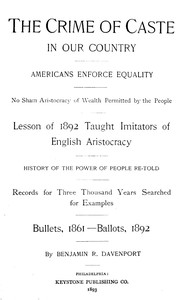
Read on Project GutenbergBenjamin Rush Davenport opens his 1893 polemic with a definition of "caste" borrowed from Portuguese colonial usage in India, then immediately pivots to declare that any attempt to create class distinctions in Free America "upon the basis of wealth or assumed social superiority, is a crime." This blunt equation—caste as a crime—sets the book's combative tone. The dedication page further frames the work: it is addressed to citizens who believe that "Patriotism, Honesty, Virtue, and Merit ALONE CONSTITUTE INEQUALITY IN MANKIND." Davenport does not mince words; his preface promises that the "Common People" will punish such crimes.
A Definition Borrowed from India
Davenport begins not with America but with a Portuguese word and the Brahminical caste system of India. He enumerates the four castes—priests, military, merchants, servile classes—and notes rules forbidding intermarriage, shared water, or dining together. This historical detour serves as a rhetorical anchor: the reader is meant to see American class pretensions as a foreign import. The author then declares that British efforts have "eradicated many of these absurd distinctions" in India, implying that Americans should be equally vigilant. The definition is not neutral scholarship; it is a weapon. By labeling wealth-based hierarchy as "caste," Davenport reframes social climbing as a betrayal of republican principles.
The Election of 1892 as a Watershed
Davenport repeatedly invokes "November the 8th, 1892" as a moment of popular awakening. In one striking metaphor, he describes a "little stream of truth trickling over the dam that holds back the flood of the resentment of the people." The dam breaks, and the rich receive "the first spray." The election is presented not as a routine political event but as a seismic shift—a verdict against arrogance. Davenport frames the contest as a continuation of the Civil War: "bullets, 1861—ballots, 1892." The implication is that the struggle for equality did not end at Appomattox but merely changed weapons. Readers encountering this language early in the text should expect a narrative that treats electoral politics as a form of ongoing warfare.
Parallels Between Southern Aristocracy and Gilded Age Wealth
Davenport draws heavily on Alexis de Tocqueville, John Stuart Mill, and Lorin Blodget to argue that agricultural societies naturally breed aristocracy. He quotes Blodget's rule that "the country wholly devoted to agriculture necessarily tends to aristocratic despotism, or some form of enslavement of the masses." The antebellum South is his prime example: large plantations, slave labor, dispersed population, poor schools. He cites Harrison's "History of Virginia" to note that in 1848 only 40,000 of 166,000 youths attended school. The point is clear: the same forces that created a landed aristocracy in the South are now, Davenport warns, reappearing in industrial form. The reader should watch for how he maps this historical argument onto contemporary Gilded Age conditions.
The Rhetoric of Resentment and Restraint
Davenport's prose is deliberately incendiary yet careful to disavow radicalism. He insists that workingmen do not seek to "overturn religion, or resort to Nihilism"; rather, they are offended by "presumption, arrogance, and overwhelming self-esteem." The metaphor of the lion's cage—"A baby's finger may touch the spring holding the bar by which is caged the lion"—suggests that the powerful are provoking a force they cannot control. Yet Davenport positions himself as a moderate voice, warning the wealthy to reform before it is too late. This tension between threat and restraint gives the book its peculiar energy. Readers should note how the author balances calls for justice with appeals to self-interest, a strategy that may reflect his intended audience of both working-class readers and uneasy elites.
Davenport's book is best approached as a period document that combines historical argument, political polemic, and moral exhortation. The excerpts reveal a writer who uses foreign examples, statistical citations, and vivid metaphor to argue that economic inequality is un-American. Readers should pay attention to the way he weaves together the 1892 election, the Civil War, and ancient Rome—a rhetorical strategy that treats all history as a single cautionary tale. The book's structure, with its numbered chapters and index, suggests it was meant for activists and debaters rather than casual readers.
Reading about the 1893 indictment of caste, I kept thinking of a dusty bench in my grandfather’s porch, where the weight of one’s name hung heavier than any coin. It reminded me of a quiet evening spent with Darkest India A Supplement to General Booth's "In Darkest England, and the Way Out" — Background and Themes, which stirred that same ache—how easily we mistake our own scaffolding for the sky.
There are no reviews for this eBook.
There are no comments for this eBook.
Reader reflection
How will you remember this book?
Save your reaction, strongest insight, and memorable passage.
Your progress
0
/
10
2
Did this book hold your interest?
3
Would you pass this book on to a friend?
4
How easy was the book to follow?
5
Did any part of the book stay with you emotionally?
6
Was the book what you thought it would be?
7
Did any part of the book feel personally relevant?
8
How useful did the reading feel?
9
In one sentence, what did you learn?
10