1

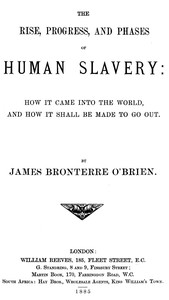
The rise, progress, and phases of human slavery How it came into the world and how it shall be made to go out — Edition Insights
(0 User reviews)
350
Project Gutenberg
2021
Not confirmed
Slavery; Social problems; Working class; Labor; Labor movement
Readers of public-domain and historical texts
Project Gutenberg digital edition
en
Edition facts
Words
79,578
Reading time
346 min
Text sections
8
This digital edition of The rise, progress, and phases of human slavery How it came into the world and how it shall be made to go out — Edition Insights is described by source-level measurements including 79,578 words, 5 hr 46 min estimated reading time, and 8 detected text sections.
The text analysis averages about 32.1 words per sentence, while the detected sections provide another way to judge how the source is divided.
Project Gutenberg metadata also associates the work with “Slavery,” connecting these edition facts with the source record’s subject description.
Source:
Project Gutenberg record #66031
An 1885 edition of James Bronterre O'Brien's unfinished history of slavery, completed posthumously from his writings. The work traces slavery from chattel to wage forms, using early Christian persecutions as a case study in how oppression spreads and resistance coheres.
Read the complete public-domain text at its original source.
Read on Project GutenbergThis edition of James Bronterre O'Brien's work, completed after his death by an editor signing as "Spartacus," opens with a dedicatory poem by William MacCall that frames the author as a martyr for truth, "prepared to fight, prepared to die, to lighten, banish, human misery." The poem sets a combative, elegiac tone that carries into the prose. The editor's preface explains that O'Brien was "frustrated in his design of finishing his History through the ceaseless machinations of working-class exploiters and landlords," and that the present text aims to give the author's ipsissima verba—his exact words—while omitting "some disquisitions on subjects of ephemeral and passing interest." The result is a work that moves between sweeping historical narrative and pointed editorial intervention, with the structure itself reflecting the unfinished, contested nature of the project.
A History Built from Fragments
The book's composition history is written into its form. O'Brien died before finishing, and the editor assembled the work from "his various writings preserved in print." This editorial process is not hidden but announced, creating a text that is both O'Brien's and not quite his. The reader encounters a layered document: the original author's voice, the editor's choices about what to include or exclude, and the explicit political aims of the edition. The preface states that the object was "to give the ipsissima verba of the Author, so that no foreign pen may garble or mislead," yet the editor also admits to omitting "some disquisitions" to make room for "the elucidation of the great reforms needed." This tension between fidelity and utility shapes every page.
Persecution as a Structural Pattern
Chapter XII, on the early Christian persecutions, reveals O'Brien's method. He does not simply list emperors and edicts; he traces how persecution escalates through a logic of state power. The "moderate" Trajan and the "philosophic" Antoninus, he notes, failed to stop Christianity—their edicts only "caused the multitude to interest themselves more." Severus's edict of 197, which prohibited conversion under severe penalties, is presented as a turning point, leading to "a frightful proscription" across the empire. O'Brien's prose moves from Rome to Gaul, Greece, Asia Minor, Egypt, tracking the spread of violence. The pattern is clear: oppression, when it fails to suppress, intensifies and widens. This structural analysis—how a ruling class's fear of a movement leads to broader repression—is the book's recurring argument.
Recurring Images of Movement and Spread
Throughout the excerpt, O'Brien uses language of motion and expansion. Christianity "went on conquering and to conquer" despite edicts. Persecutions "served to extend" the faith. The edict of Severus, meant to prevent growth, instead "gave rise to a frightful proscription" that spread across regions. This vocabulary of spread—geographical, social, ideological—mirrors the book's larger claim about slavery: that it is not a static institution but a dynamic system that adapts and expands. The early Christians, by their "discreet conduct and humane character," won converts through private life, not public proclamation. O'Brien's interest is in the mechanics of how a movement grows under pressure, a theme that connects the ancient world to his own era's labor struggles.
The Editor's Voice and the Author's Ghost
The editor, signing as "Spartacus," is a presence throughout. The preface is written in a collective voice—"we"—that claims to speak for O'Brien's legacy. The poem by MacCall, placed before the title page, addresses O'Brien directly: "Thou noble soul!—around thee gathered those / Who, poor and trampled patriots, were like thee." This framing turns the book into a monument and a call to action. The editor's note that O'Brien's life was "devoted to the advocacy of Social Rights, as distinguished from Socialistic theories" suggests a careful political positioning. The reader must navigate between O'Brien's original arguments, the editor's interpolations, and the 1885 publication context—a moment when the labor movement was redefining itself. The book is not a seamless treatise but a contested artifact.
Readers should attend to the book's layered authorship: O'Brien's unfinished manuscript, the editor's completions, and the explicit political aims of the 1885 edition. The work is best approached as a historical document of radical thought in transition, where the structure—fragmentary, assembled, polemical—is itself evidence of the struggles it describes. Pay attention to the footnotes and editorial asides, which often reveal the gaps O'Brien left and the choices made to fill them.
That 1885 edition of O’Brien had me tracing how chains change their names but not their weight, and the rain kept drumming as if agreeing. Afterwards, I found myself drifting to In an Unknown Prison Land An account of convicts and colonists in New Caledonia with jottings out and home — Text and Context, and wondered if exile is just slavery wearing a broader coat.
There are no reviews for this eBook.
There are no comments for this eBook.
Reader reflection
What did you think of this book?
Answer a few questions and save a private reflection on this device.
Your progress
0
/
10
2
Did this book hold your interest?
3
Is this a title you would suggest to others?
4
How easy was the book to follow?
5
Would this book work well in a reading group?
6
Was the book moving at the right speed?
7
How understandable was the text?
8
Do you expect to return to this book?
9
In one sentence, what did you learn?
10