1

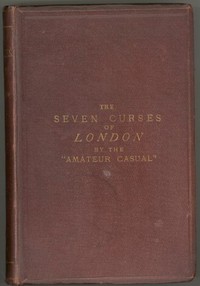
The seven curses of London — Key Ideas to Explore
(0 User reviews)
1097
Project Gutenberg
2014
Not confirmed
London (England) -- Social conditions; Crime -- England -- London -- History -- 19th century; London (England) -- Moral conditions
Readers of public-domain and historical texts
Project Gutenberg digital edition
en
Edition facts
Words
128,752
Reading time
560 min
Text sections
12
The seven curses of London — Key Ideas to Explore can be approached with a clearer sense of reading commitment from its source measurements: 128,752 words, 9 hr 20 min estimated reading time, and 12 detected text sections.
The text analysis averages about 26.0 words per sentence, while the detected sections provide another way to judge how the source is divided.
Project Gutenberg metadata also associates the work with “London (England) -- Social conditions,” connecting these edition facts with the source record’s subject description.
Source:
Project Gutenberg record #45585
James Greenwood's 1869 exposé examines seven social blights in Victorian London—neglected children, professional thieves, and more—through investigative reporting, case files, and moral argument. The catalog subjects (social conditions, crime, moral conditions) are confirmed by the text's focus on pauper children, baby-farming, and thief haunts, but the excerpts show a stronger emphasis on institutional failure and statistical claims than on moral judgment alone.
Read the complete public-domain text at its original source.
Read on Project GutenbergJames Greenwood, writing under the alias “The Amateur Casual,” opens The Seven Curses of London with a stark numerical claim: “A Hundred Thousand Children loose in London Streets.” This figure, presented without a source, sets the tone for a work that blends investigative journalism with reformist zeal. The table of contents reveals a structure built around seven categories—Neglected Children, Professional Thieves, and others—but the excerpts focus heavily on the first two, suggesting the book may treat each curse unevenly.
Greenwood’s method is to alternate between vivid vignettes (a baby-farmer interview, a thieves’ raffle) and dry institutional reports, such as case numbers from a charitable society. The catalog subjects—social conditions, crime, moral conditions—are accurate, but the excerpts reveal a text more concerned with systemic breakdowns than with simple moralizing. Greenwood’s voice is that of a crusading journalist, not a detached sociologist.
Numbers and Narratives: The Rhetoric of Scale
Greenwood repeatedly invokes large numbers to impress upon his reader the magnitude of London’s problems. He speaks of “Twenty Thousand Thieves in London” and “a Hundred Thousand Children” adrift. These figures are presented as facts, but the excerpts offer no methodological explanation. They function as rhetorical devices, lending urgency to his arguments. The text’s reliance on such statistics aligns with the catalog subject of “Social conditions,” but it also reveals a tension: Greenwood wants to be seen as an authority, yet his evidence is often anecdotal or secondhand.
When he does provide concrete data, it comes from external sources, such as the “Society’s oakum-room” case files. These numbered entries (e.g., “No. 617. F. J.”) give the work a veneer of documentary precision. However, they are selected to illustrate the society’s efficacy, not to offer a balanced view of poverty. The reader should note that Greenwood’s numbers are tools of persuasion, not neutral statistics.
The Thief’s World: Language and Locale
Greenwood devotes considerable space to the “Homes and Haunts of the British Thief,” promising to correct “Popular Misapprehensions.” He describes a “True Picture of the London Thief” and mentions “The Language of ‘Weeds’” (thieves’ cant). The excerpts include a “Fancy Sketch of the ‘Under-ground Cellar’” and a “Thieves’ Raffle,” suggesting that Greenwood used disguise to gather material—a method he pioneered as the “Amateur Casual.”
Yet the text also relies on stereotypes. The thief is portrayed as a creature of habit, living in “Little Hell” and resistant to reform. Greenwood’s account of “The Moment of Leaving Prison” and “Bad Friends” implies a deterministic cycle of crime. The catalog subject “Crime -- England -- London -- History -- 19th century” is well served, but the excerpts show that Greenwood’s interest is less in criminal psychology than in the social conditions that produce thieves. He is particularly concerned with “Juvenile Thieves” and “Budding Burglars,” whom he sees as products of neglect.
Institutional Responses: Charity and Its Limits
A significant portion of the excerpts consists of case records from a charitable society. These entries, such as “No. 883. S. F.” and “No. 169,150. S. W. G.,” detail individual applications for relief. They describe women deserted by husbands, widows losing their sight, and men seeking return fares to Manchester. The society’s interventions—providing clothes, finding situations, purchasing sewing machines—are presented as success stories.
But Greenwood also includes cases of fraud, like “No. 54,494. C. T., alias S.,” a woman who obtained money by false pretenses. This juxtaposition complicates the picture: charity can be exploited. The catalog subject “London (England) -- Moral conditions” is evident here, as Greenwood implies that the poor must be sorted into deserving and undeserving. Yet the excerpts do not resolve this tension. The reader is left to wonder whether Greenwood endorses the society’s methods or merely reports them. His own voice recedes in these passages, giving way to bureaucratic language.
The Seven Curses of London is best approached as a period document that reveals how a Victorian reformer constructed social problems through a mix of personal observation, borrowed statistics, and institutional records. The catalog subjects accurately describe its terrain, but the excerpts show a work more interested in exposing systemic failures than in moral condemnation. Readers should attend to Greenwood’s rhetorical strategies—his use of numbers, his choice of case studies, and his occasional ventriloquism of official voices—to understand how he builds his case. The book is a snapshot of a city in crisis, filtered through the lens of a journalist who believed that naming the curses was the first step to curing them.
Sometimes I think of Greenwood's children, lost in London's fog, and how little we've truly changed in how we see hardship. There's a quieter companion to that old urgency, a book that lingers on the daily texture of women's labor—not as spectacle, but as ordinary life. I find myself returning to it with the same wistful patience I’d give an old photograph. Working With the Working Woman — Themes and Context feels like that kind of company.
There are no reviews for this eBook.
There are no comments for this eBook.
Reader reflection
Before you leave, reflect on the book
Use these questions to collect your thoughts before moving on.
Your progress
0
/
10
2
How much did you enjoy the reading experience?
3
Would you pass this book on to a friend?
4
How demanding did the text feel?
5
What did you appreciate most?
6
Did any part of the book feel personally relevant?
7
Did you gain anything practical from the text?
8
How original did the book feel?
9
Which lesson or insight stayed with you?
10