1

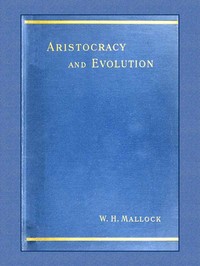
Aristocracy & Evolution A Study of the Rights, the Origin, and the Social Functions of the Wealthier Classes — Context and Discussion
(0 User reviews)
61
Project Gutenberg
2019
Not confirmed
Social sciences; Ability; Aristocracy (Social class)
Readers of public-domain and historical texts
Project Gutenberg digital edition
en
Edition facts
Words
106,840
Reading time
465 min
Text sections
20
This digital edition of Aristocracy & Evolution A Study of the Rights, the Origin, and the Social Functions of the Wealthier Classes — Context and Discussion is described by source-level measurements including 106,840 words, 7 hr 45 min estimated reading time, and 20 detected text sections.
The text analysis averages about 38.4 words per sentence, while the detected sections provide another way to judge how the source is divided.
Project Gutenberg metadata also associates the work with “Social sciences,” connecting these edition facts with the source record’s subject description.
Source:
Project Gutenberg record #58968
Mallock argues that aristocracy, defined as rule by the exceptionally gifted minority, is a natural and necessary social force, using evolutionary theory and historical examples to critique democratic and socialist ideals.
Read the complete public-domain text at its original source.
Read on Project GutenbergW. H. Mallock opens Aristocracy & Evolution by redefining aristocracy not as a hereditary class but as the rule of the exceptionally gifted and efficient minority, regardless of birth. This conceptual move allows him to frame social progress as dependent on the leadership of a natural elite. The book’s structure alternates between theoretical argument and historical illustration, with recurring images of competition, selection, and the organic growth of societies. Mallock frequently draws on analogies from biology and mechanics, such as the comparison of a governor to a physician or a letter-writer, to clarify his points.
Redefining Aristocracy as Natural Elite
Mallock explicitly distances his use of the word “aristocracy” from hereditary titles or political privileges. In the preface, he states it means “the exceptionally gifted and efficient minority, no matter what the position in which its members may have been born.” This definition is central to his argument: he treats aristocracy as a universal social phenomenon, not a historical accident. The book’s epigraphs—from Renan (“Toute civilisation est l’œuvre des aristocrates”) and Byron’s comic verse about a “little—odd—old man” leading the van—underscore this theme. Mallock’s method is to abstract the concept from its usual context and apply it to any society where a few lead the many.
Competition as the Engine of Selection
A recurring structural motif is the analysis of competition across different political systems. Mallock argues that even autocracies rely on competition: the most absolute autocrat governs through ministers who “rise and fall according as experiment shows them to be fitter or less fit.” He extends this to oligarchies and democracies, claiming that all forms of government ultimately depend on “experimental competition” to select leaders. The image of a Gladstone or Disraeli being judged by the majority illustrates his point that democracy is “experimental competition open and undisguised.” This emphasis on competition as a universal mechanism ties his social theory to evolutionary ideas.
The Governor as Physician vs. Scribe
Mallock uses a striking pair of analogies to distinguish aristocratic from democratic theories of representation. An aristocratic governor, he writes, is like a physician called in by a patient: the patient does not dispute the physician’s orders. A democratic governor, by contrast, is like a “professional Spanish letter-writer” employed by an illiterate lover to put his passion into grammatical form. This image recurs in the excerpts as a shorthand for the difference between rule by superior judgment and rule by delegated expression. Mallock’s argument hinges on the idea that democracy’s essential difference lies not in the machinery of election but in the theory of power it communicates to the elected.
The Latent Power of the Masses
Despite his defense of elite rule, Mallock acknowledges that even in autocracies the power of the multitude is “latent, and always ready to come into operation.” He cites the example of an autocrat who becomes odious and is assassinated, replaced by another candidate. This concession complicates his argument: while he insists on the necessity of exceptional individuals, he also recognizes that the masses can depose leaders. The book’s movement between theoretical abstraction and historical example—such as the reference to Juvenal’s “postquam cerdonibus esse timendus cœperat”—reveals a tension between his ideal of natural aristocracy and the practical realities of political power.
Readers approaching Aristocracy & Evolution should attend to Mallock’s careful redefinition of key terms and his reliance on analogies drawn from biology, medicine, and everyday life. The book is structured as a sustained argument against democratic and socialist theories, but it also engages with evolutionary thought in a way that reflects late-Victorian intellectual currents. Mallock’s prose is precise and often combative, and his examples—from ancient Rome to contemporary British politics—serve to ground abstract claims in concrete cases.
I keep thinking about how Mallock frames brilliance as a quiet, natural authority, and it made me remember another book that stayed with me—The Hobo: The Sociology of the Homeless Man — Text and Context. It observes lives stripped of that same social ladder, and somehow the two feel like mirrors. One argues for gifts, the other shows their absence, yet both left me oddly tender toward what we inherit.
There are no reviews for this eBook.
There are no comments for this eBook.
Reader reflection
What did you think of this book?
Answer a few questions and save a private reflection on this device.
Your progress
0
/
10
2
How did the book work for you overall?
3
Would you recommend this book to another reader?
4
What was the reading difficulty like?
5
Is this a title worth rereading?
6
Would you start a conversation about this book?
7
What was its emotional impact?
8
What did you appreciate most?
9
What did this book teach you most?
10