1

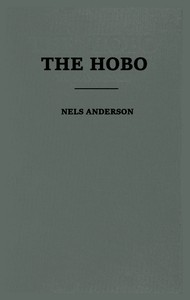
The Hobo: The Sociology of the Homeless Man — Text and Context
(0 User reviews)
333
Project Gutenberg
2022
Not confirmed
Tramps; Chicago (Ill.) -- Social conditions
Readers of public-domain and historical texts
Project Gutenberg digital edition
en
Edition facts
Words
90,082
Reading time
392 min
Text sections
48
This digital edition of The Hobo: The Sociology of the Homeless Man — Text and Context is described by source-level measurements including 90,082 words, 6 hr 32 min estimated reading time, and 48 detected text sections.
The text analysis averages about 17.5 words per sentence, while the detected sections provide another way to judge how the source is divided.
Project Gutenberg metadata also associates the work with “Tramps,” connecting these edition facts with the source record’s subject description.
Source:
Project Gutenberg record #67300
Nels Anderson's 1923 study examines the language, social codes, and survival strategies of homeless men in Chicago, using direct observation and interviews to document their subculture without moralizing.
Read the complete public-domain text at its original source.
Read on Project GutenbergNels Anderson opens The Hobo: The Sociology of the Homeless Man not with a theory but with a taxonomy: the hobo, the tramp, the bum. He distinguishes them by their willingness to work and travel, a classification that immediately signals his method—close observation of a population often reduced to stereotype. Commissioned by the Chicago Council of Social Agencies and edited by Robert E. Park, the study belongs to the early Chicago School of urban sociology, yet its voice is notably unadorned. Anderson, who had himself been a hobo, writes from inside the milieu, and his prose carries the cadence of someone reporting what he has seen rather than what he has read.
Diction and the Insider's View
Anderson’s word choices reveal his effort to let the homeless men speak through him. He uses their terms—"jungle" for campsite, "main drag" for the city’s central street, "riding the rods" for illegal train travel—without italics or apology, treating them as technical vocabulary. In the chapter on sex life, he adopts the men’s own labels: "wolf" for the older, aggressive partner and "lamb" for the younger. When he reports that a "wolf" fought to keep his "kid," he does not editorialize; he lets the quoted speech carry the emotional weight. This lexical fidelity gives the study an ethnographic texture that a purely statistical report would lack.
Dialogue as Evidence
Anderson frequently embeds direct quotations, often from unpublished documents or his own field notes. A veteran "wolf" explains his bruised face: "He was trying to get my kid into a room with him." The line is raw and unpolished, and Anderson does not clean it up. Elsewhere, a man argues that homosexual intercourse is "clean" and avoids "the eternal complications" of women. These snippets are not decorative; they function as primary data. Anderson treats speech as a window into the logic of a closed world, where men weigh risks—jail, disease, loneliness—against the fleeting intimacy of the road.
Structure and the City as Frame
The book’s organization mirrors its subject’s geography. Early chapters map the hobo’s migration routes and the "stem" of Chicago’s West Madison Street; later ones examine institutions—flophouses, missions, employment agencies. Anderson moves from the open road to the urban core, then to the body and the self. The chapter on citizenship asks where the hobo "stands in relation to organized society," a question that echoes the editor’s preface, where Park notes that the pioneer becomes a vagrant in the city. Anderson’s structure thus enacts a descent from mobility to stasis, from freedom to marginalization.
Recurring Details and the Weight of Numbers
Anderson leavens his qualitative observations with tables and percentages, but the numbers often underscore the human cost. He reports that 86 percent of the 400 men he interviewed were unmarried, and only 5 percent claimed to be married. These figures appear alongside accounts of men who have lost contact with families or never formed one. In the sex-life chapter, he cites the Vice Commission of Chicago to note that homosexual practices "do not, as a rule, produce bodily disease"—a clinical fact that contrasts sharply with the violence and loss he describes. The interplay of statistic and story is Anderson’s quiet argument: the hobo’s condition is both personal and structural.
The Investigator as Participant
Anderson does not hide his own role. He recounts two attempts to intervene between a "wolf" and his "lamb," one resented by both parties, the other "rather enjoyed by the boy, though he would not be separated." These moments are rare but telling: the sociologist is not a fly on the wall but a presence who tests the boundaries of the subculture. He is arrested, he is bruised, he is refused. By including his failures, Anderson acknowledges the limits of observation and the stubborn reality of the world he studies.
Readers should approach The Hobo as a document of its time—1923 Chicago, with its flophouses and freight yards—but also as a record of how one researcher tried to make a despised population legible without sentimentality. Anderson’s method, blending census data with the argot of the road, remains instructive. Pay attention to the footnotes: they point to unpublished documents and commission reports that anchor his claims. The book is not a complete portrait—Anderson acknowledges that much lies beyond his scope—but it is a careful, often unsettling, act of attention.
I kept thinking about Anderson’s hobos, their quiet codes and makeshift dignity, long after I closed the book. It made me wonder how people endure, really. Then someone handed me The condition of England — A Closer Reading, and that same ache of watching lives pressed hard by circumstance came back, softer but unmistakable.
There are no reviews for this eBook.
There are no comments for this eBook.
Reader reflection
How did this book work for you?
Your answers remain private and are stored only in this browser.
Your progress
0
/
10
2
Did this book hold your interest?
3
Is this a title you would suggest to others?
4
What was the reading difficulty like?
5
Is this a title worth rereading?
6
How did the pace of the book feel?
7
Did it raise ideas you would like to talk about?
8
Could you apply anything you learned?
9
What changed or sharpened your thinking?
10