1

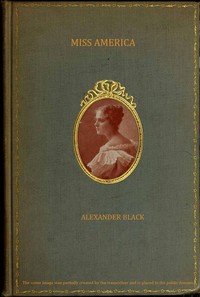
Miss America; pen and camera sketches of the American girl — Text and Context
(0 User reviews)
82
Project Gutenberg
2022
Not confirmed
Women -- United States -- Social conditions; Women -- United States
Readers of public-domain and historical texts
Project Gutenberg digital edition
en
Edition facts
Words
35,789
Reading time
156 min
Text sections
11
Miss America; pen and camera sketches of the American girl — Text and Context can be approached with a clearer sense of reading commitment from its source measurements: 35,789 words, 2 hr 36 min estimated reading time, and 11 detected text sections.
The text analysis averages about 22.6 words per sentence, while the detected sections provide another way to judge how the source is divided.
Project Gutenberg metadata also associates the work with “Women -- United States -- Social conditions,” connecting these edition facts with the source record’s subject description.
Source:
Project Gutenberg record #68869
Alexander Black's 1898 'pen and camera sketches' examine the American girl through a blend of social commentary and photographic portraiture, focusing on conversational habits, social rituals, and the tension between individual character and national type.
Read the complete public-domain text at its original source.
Read on Project GutenbergAlexander Black opens his 1898 volume with an apology rather than a preface, signaling the informal, observational mode of these 'pen and camera sketches.' He acknowledges the difficulty of capturing a national type through photography, noting that the lens can only offer a sketch, and that the portraits span six or seven years, supplemented by costume studies of earlier eras. Black explicitly distinguishes the 'United States girl' from the broader American identity, a precision that shapes his entire project.
Conversation as Social Barometer
Black devotes considerable attention to the art of talk, measuring the American girl against historical benchmarks. He cites Mme. De Staël's claim that conversation 'exists only in France' and Mrs. Poyser's observation that a woman 'can count a stocking top while a man's gitting his tongue ready.' His own diagnosis is that modern society talk, under pressure of numbers and rapid movement, resembles 'the scattered fragments of a word game.' The ideal tête-à-tête, he implies, has been sacrificed to the 'giggle, gabble, gobble, git' of fashionable rushing.
The Velocity of Social Life
Black laments the transformation of calling customs, noting that sipping tea in a dozen rooms on the same afternoon is a worse matter than the old practice of lingering in one. He invokes the 'Autocrat of the Breakfast Table' to capture the 'distressing celerity' with which women rush through social obligations. The 'intoxication of mere rapidity' persists, he argues, despite the potency of pasteboard and imagination. This critique of speed as a social value recurs throughout the sketches.
Photography and the Limits of Type
Black's preface acknowledges the difficulty of expressing the American type through the lens, a challenge not diminished by 'wide travel.' He withholds geographical identities of his subjects, a reservation he compares to those 'which the American girl herself so frequently chooses to hold.' The photographs are presented as sketches, not definitive portraits, and the text often works against the grain of generalization, insisting on the particularity of individual subjects.
Historical Precedents and Modern Contrasts
Black draws on a range of historical references to frame his observations. He contrasts the spectacular talking of old French salons—Mme. Récamier addressing a dozen men at once—with the fragmented attention of modern gatherings. He quotes Addison's lament over 'proud, idle flirts sipping their tea' and Margaret Fuller's complaint about Carlyle's monologues. These allusions serve not as pedantry but as a measure of what has been lost in the shift from sustained conversation to rapid social oscillation.
Black's sketches resist easy summary; they are as much about the difficulty of capturing a type as about the type itself. Readers attentive to the interplay between text and image will notice how the author's own reservations—about photography, about generalization, about the term 'American'—mirror the elusiveness of his subject. The book rewards those who read for the specific observation rather than the sweeping claim.
There’s something tender about how Alexander Black’s pen and camera sketches caught American girls mid-conversation, caught between who they were and who their era expected them to be. I keep remembering that tension—the ache of a type pressing against a person. It lingered in me the way West Side Studies: Boyhood and Lawlessness; The Neglected Girl — Themes and Context does now, that same quiet sorrow for girls seen only as categories, never as themselves.
There are no reviews for this eBook.
There are no comments for this eBook.
Reader reflection
Your personal reading reflection
Build a private reading journal entry for this title.
Your progress
0
/
10
2
How much did you enjoy the reading experience?
3
Would you encourage someone else to read it?
4
How easy was the book to follow?
5
How clear did the writing feel?
6
Did any part of the book feel personally relevant?
7
Would you read this book again?
8
Did the book offer a fresh perspective?
9
Which lesson or insight stayed with you?
10