1

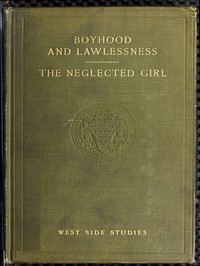
West Side Studies: Boyhood and Lawlessness; The Neglected Girl — Themes and Context
(0 User reviews)
40
Project Gutenberg
2019
Not confirmed
Girls; Boys; New York (N.Y.) -- Social conditions; Poor -- New York (State) -- New York; Women -- Employment -- New York (State) -- New York; Juvenile delinquency; Social surveys -- New York (State) -- New York; Juvenile courts -- New York (State) -- New York
Readers of public-domain and historical texts
Project Gutenberg digital edition
en
Edition facts
Words
103,227
Reading time
449 min
Text sections
13
Before opening West Side Studies: Boyhood and Lawlessness; The Neglected Girl — Themes and Context, the edition data offers a quick orientation: 103,227 words, 7 hr 29 min estimated reading time, and 13 detected text sections.
The text analysis averages about 17.5 words per sentence, while the detected sections provide another way to judge how the source is divided.
Project Gutenberg metadata also associates the work with “Girls,” connecting these edition facts with the source record’s subject description.
Source:
Project Gutenberg record #60116
This 1914 social survey examines juvenile delinquency among boys and girls in a West Side New York tenement district, using statistical tables and case records to analyze court dispositions, parental conditions, and group offending patterns.
Read the complete public-domain text at its original source.
Read on Project GutenbergThe West Side Studies, directed by Pauline Goldmark and based on fieldwork completed in 1912, focus on an 80-block area along the Hudson River between Thirty-fourth and Fifty-fourth Streets. The population, described as a “backset” from the city’s main current, is predominantly Irish and German stock, with the more ambitious having moved away. The two reports—Boyhood and Lawlessness and The Neglected Girl—draw on juvenile court records and case investigations to examine how the neighborhood’s social conditions shape delinquency.
Ruth S. True, the contributor, organizes the data around legal categories: juvenile delinquency cases (for offenses) and special proceedings (for neglect or dependency). The excerpts include extensive tables showing ages, dispositions, and parental status, alongside charts that visualize the disproportionate number of boys arraigned compared to girls.
Statistical Framing of Delinquency
The reports rely heavily on tabular data from the New York Juvenile Court, breaking down cases by sex, age, and disposition. For example, Table XVI shows that among boys arraigned for juvenile delinquency, nearly half (48.7%) were aged 14 or 15, while girls in the same category were far fewer—only 91 total, with 48.3% also in that age range. In special proceedings, however, girls appear in larger numbers: 32.0% of girls were aged 7 and under, compared to 21.9% of boys. This suggests that younger girls were more often brought before the court for neglect or dependency rather than for offenses.
The tables also track group delinquency: 45.5% of all cases involved children arraigned singly, while 22.1% were in pairs and 32.4% in groups of three or more. The text does not elaborate on the nature of these groups, but the data implies that peer associations were a significant factor in court appearances.
Parental Condition and Court Outcomes
Table XX details the parental condition of children investigated. Among juvenile delinquency cases, 15.8% had lost their father, 7.7% their mother, and 1.8% were orphaned. Desertion by a father occurred in 2.6% of cases, and by a mother in only 0.4%. These figures are presented without commentary on causation, but they provide a demographic baseline for understanding the home environments of arraigned children.
Disposition tables reveal that for all cases, 40.9% were summarily disposed of, 43.0% were remanded (temporarily detained), and 16.1% were paroled. Among adjudged delinquents, 44.4% were placed on probation, 22.8% had sentences suspended, and 15.5% were committed without probation. The reports do not explain the criteria for these outcomes, leaving the reader to infer that the court had a range of responses, with probation being the most common.
Narrative Voice and the Limits of the Excerpts
The excerpts available are almost entirely composed of prefatory material and statistical tables, with little of True’s analytical prose. The preface, written by Goldmark, explains the survey’s origins and the selection of the West Side district, noting that the population was “homogeneous and stable” yet included “the wrecks of the population.” This phrasing carries a judgmental tone that contrasts with the neutral presentation of numbers.
The tables themselves are dense and lack interpretive headers, forcing the reader to parse columns like “Remanded” and “Paroled” with footnoted definitions. Without the full narrative chapters, it is impossible to assess how True connected these statistics to individual case histories or to broader arguments about lawlessness and neglect. The voice that emerges is that of a systematic investigator, but the human stories behind the figures remain absent from these excerpts.
Readers approaching this work should be prepared to engage with its quantitative core: the tables are the primary evidence, and the missing analytical text may require inferring the authors’ arguments from the data alone. The preface offers context about the survey’s methodology and the neighborhood’s character, but the excerpts do not reveal how the two reports—on boys and girls—relate to each other or whether they share a unified thesis. Attention to the footnotes and table headings will clarify the legal categories that structure the findings.
That rain made the alley outside blur into the ledger pages detailing what the boys never had. Hours passed; I noticed a footnote about property laws shaping a court decision. It nudged me toward an older, quieter question about who owns what and why. I set down one survey and found Aristocracy & Evolution A Study of the Rights, the Origin, and the Social Functions of the Wealthier Classes — Context and Discussion, which felt like turning the page to a dawn.
There are no reviews for this eBook.
There are no comments for this eBook.
Reader reflection
How did this book work for you?
Your answers remain private and are stored only in this browser.
Your progress
0
/
10
2
How did the book work for you overall?
3
Is this a title you would suggest to others?
4
Did the language feel accessible?
5
Did it raise ideas you would like to talk about?
6
Would a second reading be valuable?
7
Could you follow the author’s main argument?
8
Which aspect of the book did you value most?
9
Which lesson or insight stayed with you?
10