1

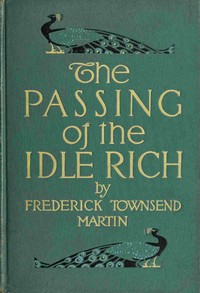
The Passing of the Idle Rich — A Reader’s Guide
(0 User reviews)
913
Project Gutenberg
2020
Not confirmed
United States -- Social conditions -- 1865-1918; Wealth -- United States; Rich people -- United States
Readers of public-domain and historical texts
Project Gutenberg digital edition
en
Edition facts
Words
37,927
Reading time
165 min
Text sections
25
Before opening The Passing of the Idle Rich — A Reader’s Guide, the edition data offers a quick orientation: 37,927 words, 2 hr 45 min estimated reading time, and 25 detected text sections.
The text analysis averages about 22.4 words per sentence, while the detected sections provide another way to judge how the source is divided.
Project Gutenberg metadata also associates the work with “United States -- Social conditions -- 1865-1918,” connecting these edition facts with the source record’s subject description.
Source:
Project Gutenberg record #63001
Frederick Townsend Martin, a self-described insider, critiques the American wealthy class in this 1911 polemic. He argues that idle riches breed social decay and predicts a populist uprising. The book contrasts European and American plutocracies, using historical parallels like Rome and France to frame its argument.
Read the complete public-domain text at its original source.
Read on Project GutenbergFrederick Townsend Martin opens The Passing of the Idle Rich with a claim of authority: 'I know Society. I was born in it, and have lived in it all my life.' This insider stance shapes the book's rhetorical strategy. Martin does not merely observe from afar; he positions himself as a defector from the oligarchy he condemns. The prose is direct and declarative, often employing parallel structure and stark contrasts—'cleaner, saner and more normal' versus 'hideous abnormalities'—to frame his critique. The work is less a sociological study than a sustained argument, laced with historical analogies and a sense of impending crisis.
The Insider's Authority
Martin's opening gambit is to establish his credentials: 'I know Society. I was born in it, and have lived in it all my life.' This is not a neutral observation but a strategic claim to credibility. He bolsters this by noting his familiarity with both American and European high society, implying a comparative perspective that lends weight to his judgments. The phrase 'hideous abnormalities that in these later years have been grafted upon it' reveals his stance: he sees a corruption of an originally sound institution. His tone is that of a disillusioned insider, one who can diagnose the disease because he has seen the patient from within.
The Plutocracy's Leadership Deficit
Martin devotes considerable attention to the question of leadership among the wealthy. He argues that the American plutocracy lacks a single commanding figure, unlike historical examples such as Marius in Rome or Cromwell in England. Instead, he observes a tendency for the wealthy to 'divide into rival camps,' citing Wall Street finance as a microcosm where leaders are 'bitterly antagonistic, fiercely at odds.' This fragmentation, he suggests, weakens the plutocracy's ability to mount a unified defense against popular movements. The language is martial: 'the golden host,' 'reinforcements,' 'break down or destroy.' Martin frames class conflict as a war of position, where the wealthy are hampered by internal discord.
Historical Parallels and the People's Leader
Martin repeatedly invokes historical precedents to argue that popular uprisings inevitably produce leaders. He cites Marius, Danton, Robespierre, and Cromwell as figures who 'when once they are fired with enthusiasm for a cause, have been able... to lead the minds of the people as they willed.' The implication is clear: America awaits its own such leader. Martin is careful not to predict the form this leadership will take, but he insists it will arise: 'We need a leader. He will surely come.' This section is notable for its rhetorical escalation, moving from analysis to prophecy. The historical examples serve both as evidence and as a warning to the idle rich.
The Vocabulary of Class Conflict
Martin's diction consistently frames class relations in terms of struggle and exploitation. He speaks of 'the never-ceasing conflict between the people and their exploiters,' and describes plutocrats as 'heavy pensioners upon' the laboring class. The Lincoln epigraph sets the tone: 'useful labour, useless labour, and idleness' are the three categories, with idleness condemned as parasitic. Martin's prose is peppered with terms like 'oligarchy,' 'tyranny,' 'slaves,' and 'traitors.' This is not a dispassionate analysis but a polemic that borrows the language of revolution. The repeated use of 'plutocracy' rather than 'wealthy' or 'upper class' is a deliberate choice, emphasizing rule by money rather than by birth or merit.
Martin's book is best approached as a period piece of progressive-era polemic, rich in rhetorical flair and historical analogy. Readers should note that the excerpts provide only a partial view; the full text likely develops its arguments across eleven chapters. The author's insider status and his use of first-person testimony give the work a distinctive voice, but his claims should be weighed against other contemporary accounts. For those interested in the language of class conflict in early twentieth-century America, this is a revealing document.
Reading about Martin’s idle rich, I thought of my grandfather’s summer porch, where he’d mutter about wasted Sundays. That feeling returned with The seven curses of London — Key Ideas to Explore, which stirred the same quiet ache for forgotten streets and their hidden tolls. Both books whisper that neglect is never neutral, just a slow, patient debt.
There are no reviews for this eBook.
There are no comments for this eBook.
Reader reflection
Your personal reading reflection
Build a private reading journal entry for this title.
Your progress
0
/
10
2
How did the book work for you overall?
3
How likely are you to recommend this book?
4
How easy was the book to follow?
5
Was the book moving at the right speed?
6
How well did it match your expectations?
7
Did you relate to its people, ideas, or situations?
8
How strongly did the book affect you emotionally?
9
What is the main idea you are taking away?
10