
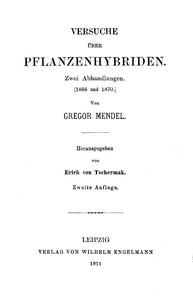
Versuche über Pflanzenhybriden by Gregor Mendel
Okay, picture this: it's the 1860s in what's now the Czech Republic. Gregor Mendel, an Augustinian monk and part-time science teacher, is puttering around in his monastery's garden. He's not just growing peas for soup. He's on a mission. He's carefully breeding different kinds of pea plants—crossing tall ones with short ones, plants with yellow peas with those that have green ones—and then meticulously counting the results in the next generation. For years, he tracked over 28,000 plants, recording heights, colors, and pod shapes. He wasn't just observing; he was finding clear, mathematical patterns in how traits passed from parents to offspring.
Why You Should Read It
Reading Mendel's original paper is like getting a backstage pass to a massive discovery. You see his brilliant, patient mind at work. He cut through the fuzzy thinking of his era with simple experiments and clear numbers. He figured out the concepts of dominant and recessive traits and laid out the basic laws of heredity with nothing but peas, paper, and persistence. It's incredibly humble and profoundly powerful at the same time. You're witnessing the moment genetics was born, written in a straightforward, logical style.
Final Verdict
This is for the curious reader who loves a great 'hidden gem' story. It's perfect if you're into science history, enjoy seeing how a big idea starts small, or just appreciate a brilliant mind explaining something complex with beautiful simplicity. Don't expect a novel—it's a scientific paper. But within those pages is a quiet revolution that explains a fundamental part of life itself. It's a foundational text that's surprisingly accessible and utterly fascinating.
This book is widely considered to be in the public domain. Enjoy reading and sharing without restrictions.
Christopher Hill
10 months agoAs someone who reads a lot, the flow of the text seems very fluid. Absolutely essential reading.
Edward White
1 year agoComprehensive and well-researched.
Michael Sanchez
11 months agoTo be perfectly clear, the narrative structure is incredibly compelling. A true masterpiece.
Emma Johnson
10 months agoI was skeptical at first, but the depth of research presented here is truly commendable. One of the best books I've read this year.
Steven Johnson
4 months agoWithout a doubt, the depth of research presented here is truly commendable. I will read more from this author.