1

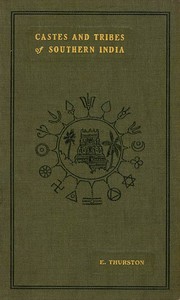
Castes and Tribes of Southern India. Vol. 2 of 7 — Story, Setting & Ideas
(0 User reviews)
342
Project Gutenberg
2013
Not confirmed
Caste -- India, South; Tribes -- India, South; Ethnology -- India, South; India, South -- Social life and customs
Readers of public-domain and historical texts
Project Gutenberg digital edition
en
Edition facts
Words
155,932
Reading time
678 min
Text sections
26
For Castes and Tribes of Southern India. Vol. 2 of 7 — Story, Setting & Ideas, the stored edition analysis reports 155,932 words, 11 hr 18 min estimated reading time, and 26 detected text sections.
The text analysis averages about 20.4 words per sentence, while the detected sections provide another way to judge how the source is divided.
Project Gutenberg metadata also associates the work with “Caste -- India, South,” connecting these edition facts with the source record’s subject description.
Source:
Project Gutenberg record #42992
This volume catalogues castes and tribes from C to J, detailing customs, occupations, and social hierarchies through ethnographic observations, with recurring motifs of ritual objects, performance, and material culture.
Read the complete public-domain text at its original source.
Read on Project GutenbergThe second of seven volumes, this work proceeds alphabetically through castes and tribes from C to J, each entry a capsule of ethnographic detail. The structure is encyclopedic, yet the entries often break from dry cataloguing into vivid, almost theatrical scenes—such as the Gangeddulu mendicants who exhibit performing bulls, complete with a staged marital quarrel and a padded-horn charge. The volume’s recurring interest in ritual objects—the tāli tied to an āvaram branch, the square space for marriage offerings—anchors abstract social categories in tangible, often surprising, material practices.
Alphabetical Order as a Frame for Social Complexity
The volume’s alphabetical arrangement—from Canji (gruel) to Jōgi mendicant—imposes a neutral order on a deeply hierarchical social landscape. Yet the entries resist neat classification. A single term like Chakkiliyan opens onto disputes over rank, migration patterns, and religious syncretism (nominally Saivite but “in reality devil-worshippers”). The structure allows the reader to move abruptly from a weaver’s sept named after rice-water to a leather-worker caste’s marriage rituals, highlighting how occupational and ritual identities intersect. The alphabetical frame does not flatten difference; it juxtaposes groups that might otherwise be kept separate in social practice, creating a mosaic of Southern Indian life.
Recurring Images: Ritual Objects and Bodily Marks
Across entries, certain objects recur with emblematic force. The tāli (marriage necklace) is tied to a branch of the āvaram plant among Chakkiliyans; the chank and chakram are branded on the shoulders of Gangeddulu initiates. These are not mere accessories but markers of identity and divine connection. The square space (Chadarapu Dhompti) for food offerings among a Mādigas sub-division similarly materializes a ritual boundary. The volume’s attention to such objects—often described with precise local terms—grounds abstract caste categories in sensory, material culture. Readers will notice how these items travel across entries, linking disparate groups through shared symbolic vocabularies.
Movement Between Scenes: From Temple to Street Performance
The excerpts shift between institutional settings—Brāhman temples, government museums—and itinerant performances. The Gangeddulu entry is the most extended example: a bull’s exhibition moves from village street to house-to-house begging, with a scripted drama of marital discord. The keeper’s “dismal, booming” drum and “piercing voice” contrast with the silent, trained animal. This scene is framed by notes on temple donations of deformed calves and village worship, showing how the same animal circulates between sacred and economic spheres. The volume repeatedly stages such movements—from the domestic interior (marriage offerings) to public spectacle—revealing caste as performed as much as inherited.
The Ethnographer’s Voice: Citation and Anecdote
Thurston and Rangachari weave together multiple sources: census reports, earlier ethnographers like H. A. Stuart, and credited informants such as Mr. C. Hayavadana Rao. The result is a layered text where official statistics sit beside anecdotal detail. For instance, the Gangeddulu entry begins with a general description, then shifts to a first-person note from Rao, who adds specifics about calf acquisition and village worship. This polyvocality gives the volume a provisional quality—knowledge is attributed, not asserted. Readers should attend to these shifts in voice, as they signal where the authors are synthesizing versus reporting direct observation. The effect is a text that feels both authoritative and open to revision.
This volume rewards readers who move between entries, tracing how a ritual object or performance type appears across different castes. The alphabetical structure invites comparison, but the real connections lie in the recurring details: the tāli, the branded emblem, the trained animal. Approach the work as a mosaic rather than a dictionary, and note how the ethnographers’ own voices—sometimes citing, sometimes narrating—shape the portrait of Southern Indian social life.
I kept thinking about how those ritual objects in the C-to-J volume seemed to carry whole lives inside them—like they were just waiting for someone patient to listen. It reminded me of something quieter I came across, Modern Woman: Her Intentions — A Reader’s Guide, where the same feeling of unspoken weight lingers. That book stayed with me long after I set it down, almost like an old photograph you find and can’t quite place.
There are no reviews for this eBook.
There are no comments for this eBook.
Reader reflection
Record your reading impressions
A brief reflection can help important ideas stay with you longer.
Your progress
0
/
10
2
How did the book work for you overall?
3
Would you pass this book on to a friend?
4
How easy was the book to follow?
5
How clear did the writing feel?
6
Is this a title worth rereading?
7
Which element worked best for you?
8
Would you like to discuss this book with someone?
9
What did this book teach you most?
10