1

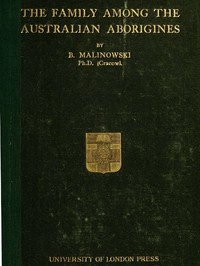
The Family among the Australian Aborigines, a Sociological Study — Edition Insights
(0 User reviews)
1405
Project Gutenberg
2015
Not confirmed
Ethnology -- Australia; Aboriginal Australians -- Social life and customs; Families -- History
Readers of public-domain and historical texts
Project Gutenberg digital edition
en
Edition facts
Words
127,364
Reading time
554 min
Text sections
22
The catalog record for The Family among the Australian Aborigines, a Sociological Study — Edition Insights provides practical reading context through 127,364 words, 9 hr 14 min estimated reading time, and 22 detected text sections.
The text analysis averages about 20.2 words per sentence, while the detected sections provide another way to judge how the source is divided.
Project Gutenberg metadata also associates the work with “Ethnology -- Australia,” connecting these edition facts with the source record’s subject description.
Source:
Project Gutenberg record #48865
Bronislaw Malinowski's 1913 monograph examines the Australian Aboriginal family through a functionalist lens, emphasizing emotional ties and daily life over speculative origins. Based on ethnographic reports, the study argues that kinship must be understood via collective feelings and social functions, not merely legal norms.
Read the complete public-domain text at its original source.
Read on Project GutenbergBronislaw Malinowski's 1913 monograph opens with a methodological challenge: to study the family among Australian Aborigines not by tracing hypothetical origins but by examining its actual workings. The foreword declares that even setting aside questions of development, the institution's complexity demands attention to emotional bonds, magico-religious ideas, and customary norms. Malinowski insists that a full picture requires treating kinship as a living system embedded in daily life and collective psychology.
A Functionalist Framework
The study's theoretical scope is set early: Malinowski aims to demonstrate that sociological inquiry must integrate facts often neglected—the emotional side of family relations, the role of collective feelings, and the interplay of legal and customary norms. He argues that personal ties consist not only of ideas but also of feelings, and that these feelings are as socially determined as collective ideas. This functionalist approach, though nascent here, anticipates his later work. The excerpts show him grappling with how to treat emotions as determinate objects of study, countering objections that they are too shapeless for scientific analysis.
Emotion as Collective Fact
Malinowski devotes careful argument to the concept of 'collective feelings'—types of feeling transmitted across generations, imposing themselves on individuals and connected to social institutions. He illustrates this with the hypothetical case of a promiscuous society where individual parental affection could not exist, only a 'group affection.' The text insists that the parent-child relation cannot be treated without its emotional character. Yet he acknowledges the difficulty: feelings are indeterminate and hard to ascertain. His solution is to point to Australian evidence, where the sentimental side of kinship is, he claims, better documented than any other aspect.
Structure of the Argument
The work's structure moves from theoretical framing to ethnographic detail. The foreword outlines a dual aim: to collect facts and to demonstrate a general principle. Malinowski repeatedly stresses the need to study institutions 'in all their complex social functions' and their reflection in collective psychology. The excerpts reveal a methodical, almost legalistic style of argument—building propositions, anticipating objections, and citing ethnographic reports. The text is dense with footnotes and references, reflecting its origin as a doctoral thesis. Readers should expect a systematic, if occasionally repetitive, exposition.
Recurring Images of Kinship
Throughout the excerpts, Malinowski returns to the image of kinship as a web of personal ties determined by mutual feelings. He contrasts this with purely formal or legal definitions. The phrase 'living man in a living society' recurs as a touchstone. He also invokes the idea of 'functional dependence' (borrowed from mathematics) to describe how feelings and institutions interrelate. These images—of organic connection, of emotion crystallizing into ideas—reinforce his central thesis: that family relations are dynamic, not static, and must be studied as they are lived.
Malinowski's study is best approached as an early attempt to systematize the sociology of kinship through a functionalist lens. Readers should attend to how he builds his case from ethnographic fragments, and note the tension between his theoretical ambitions and the limitations of his sources. The work rewards those interested in the history of anthropology and the development of field methods.
The rain kept tapping the window while I underlined Malinowski’s quiet insistence on felt bonds over bare rules. Afterwards, idling, his pages led me to wonder how deep such unspoken ties might run—beyond kinship, into inherited taboos themselves. That afternoon softened into Taboo and genetics — Context and Discussion, a quieter companion, though the connection felt less like research than weather settling.
There are no reviews for this eBook.
There are no comments for this eBook.
Reader reflection
What did you think of this book?
Answer a few questions and save a private reflection on this device.
Your progress
0
/
10
2
How did the book work for you overall?
3
Would you encourage someone else to read it?
4
How much effort did this book require?
5
How distinctive were its ideas or approach?
6
Was the book moving at the right speed?
7
Did the book meet your expectations?
8
Could you follow the author’s main argument?
9
Which lesson or insight stayed with you?
10