1

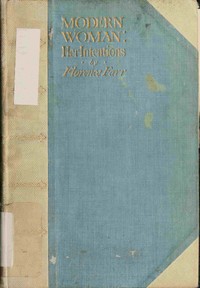
Modern Woman: Her Intentions — A Reader’s Guide
(0 User reviews)
1544
Project Gutenberg
2022
Not confirmed
Women -- Social conditions; Marriage; Women -- History
Readers of public-domain and historical texts
Project Gutenberg digital edition
en
Edition facts
Words
18,281
Reading time
80 min
Text sections
2
This digital edition of Modern Woman: Her Intentions — A Reader’s Guide is described by source-level measurements including 18,281 words, 1 hr 20 min estimated reading time, and 2 detected text sections.
The text analysis averages about 26.2 words per sentence, while the detected sections provide another way to judge how the source is divided.
Project Gutenberg metadata also associates the work with “Women -- Social conditions,” connecting these edition facts with the source record’s subject description.
Source:
Project Gutenberg record #67912
Florence Farr's 1910 polemic dissects marriage, prostitution, and women's economic dependence, arguing that social contempt—not inherent vice—degrades women. Excerpts reveal a frank, unsentimental voice that treats love as tidal and flirtation as a vital amusement.
Read the complete public-domain text at its original source.
Read on Project GutenbergFlorence Farr’s 1910 Modern Woman: Her Intentions opens with a striking epigraph from W. B. Yeats—‘Another fire has come into the harp’—and proceeds to argue that women’s economic dependence is the root of their social subordination. Farr, a noted actress and occultist, writes with a bluntness that defies early twentieth-century decorum: she discusses prostitution as a ‘trades union’ matter, compares marriage to a business partnership, and insists that ‘the money bargain’ is a device invented by unattractive men. The catalog subjects—Women—Social conditions, Marriage, Women—History—accurately frame the book’s terrain, but the excerpts reveal a work less concerned with historical narrative than with immediate, practical reform. Farr’s voice is sardonic, unsentimental, and grounded in statistical claims (e.g., ‘six million bachelors and seven million spinsters in England and Wales’). She does not offer a systematic history but a polemic aimed at unsettling complacent assumptions about love, marriage, and female virtue.
Love as Tide, Not Anchor
Farr’s treatment of love is deliberately anti-romantic. She describes women’s affections as ebbing and flowing ‘with the sweep of a tide,’ while men’s love ‘glittered and dulled like the shaken silver of the waves.’ This metaphor recurs in the excerpts and signals a core argument: permanent monogamy is unnatural for many people. Farr cites ‘the evidence of history and psychiatry’ to claim that humans are ‘not naturally unitarian in their affections.’ She does not name her sources, but the reference suggests she is engaging with contemporary sexological debates. Importantly, she distinguishes between emotional and sensual infidelity: ‘I do not think it is often her sensual nature, but her emotional nature, that makes a woman unfaithful.’ This distinction allows her to defend flirtation as a legitimate emotional outlet, especially for childless wives who ‘begin to feel like a withered rose tree.’ The tone is clinical yet sympathetic, and the argument is explicitly tied to race improvement—a common eugenic concern of the period.
The Economics of Intimacy
Farr devotes an entire chapter to ‘Women’s Incomes,’ and the excerpts show her linking financial dependency directly to sexual exploitation. She writes that ‘the sale of virginity’ and prostitution ‘come under the general consideration whether it is right for any woman to become the property of a man in exchange for money.’ Her solution is not moral condemnation but economic independence, which she calls ‘a way of ennobling sex relations.’ She also advocates for sanitary regulation of prostitution, urging married women to ‘do all they can to make the conditions of prostitutes sanitary.’ This pragmatic, public-health approach contrasts with the moral outrage typical of many contemporaries. Farr’s catalog subject ‘Social Conditions’ is thus rendered specific: she is not describing conditions but prescribing reforms. The excerpts also reveal a sharp eye for class distinctions—she notes that ‘a working man’s wife’ faces different pressures than an heiress, and she mocks the ‘sordidness of English divorce’ with its ‘restitution of conjugal rights.’
Contempt as Social Engine
A recurring thread in the excerpts is Farr’s insistence that contempt—not inherent vice—degrades women. She writes that ‘if women are degraded it is generally because they have been treated with contempt, and not because they are essentially any more contemptible than the rest of us.’ This claim appears in the context of prostitution, but it echoes her broader critique of marriage. She observes that ‘permanent relations often founded on mutual contempt’ and that ‘the ostracism of the unfaithful is more often the cause of disease becoming serious than infidelity.’ The logic is consistent: social stigma creates the very problems it purports to solve. Farr’s voice here is coolly analytical, almost anthropological. She refers to ‘the green houses of Japan’ (likely a reference to Edmond de Goncourt’s account of Tokyo courtesans) as a model of regulated prostitution, and she repeatedly returns to the idea that ‘the marriage tie must persist because it suits one half of the population’—the half that benefits from the status quo. This structural critique, grounded in specific examples, gives the book its polemical edge.
Readers approaching Modern Woman: Her Intentions should set aside expectations of a systematic treatise. Farr’s method is associative, moving from statistics to anecdote to metaphor within a single paragraph. The book is best read as a series of provocations—some startlingly modern, others tethered to early twentieth-century eugenic discourse. Pay attention to the rhetorical shifts: Farr can be by turns sardonic, clinical, and earnest. The excerpts suggest that her central concern is not women’s nature but the social arrangements that constrain it. Whether one agrees with her remedies, her willingness to name the unnameable—contempt, boredom, the money bargain—makes this a document worth engaging on its own terms.
Re-reading Farr’s unhurried honesty about love’s shifting tides, I found myself thinking of how rarely we grant such grace to our own past selves. Her contempt-free gaze feels like a quiet mercy. That patience echoes in Social Origins and Primal Law — A Closer Reading, where old instincts are met with the same gentle curiosity, not judgment. Just a thought that lingered.
There are no reviews for this eBook.
There are no comments for this eBook.
Reader reflection
Your personal reading reflection
Build a private reading journal entry for this title.
Your progress
0
/
10
2
What was your overall reaction to the book?
3
Would you pass this book on to a friend?
4
How demanding did the text feel?
5
How useful did the reading feel?
6
How strong was your personal connection to the text?
7
How clear did the writing feel?
8
Was the book what you thought it would be?
9
In one sentence, what did you learn?
10