About 370 minutes
The condition of England — A Closer Reading
Social Conditions
85,093 recorded words. 8 minutes difference from this book's estimate.
View Gutenberg source #70267
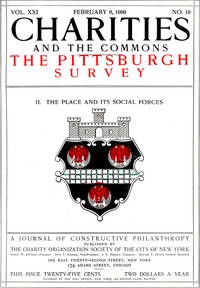
This digital edition of Charities and the Commons: The Pittsburgh Survey, Part II. The Place and Its Social Forces — Inside the Classic is described by source-level measurements including 86,827 words, 6 hr 18 min estimated reading time, and 12 detected text sections.
The text analysis averages about 23.5 words per sentence, while the detected sections provide another way to judge how the source is divided.
Project Gutenberg metadata also associates the work with “Pittsburgh (Pa.) -- Social conditions,” connecting these edition facts with the source record’s subject description.
Explore this collection
These alternatives are selected using recorded categories and estimated reading time.
About 370 minutes
Social Conditions
85,093 recorded words. 8 minutes difference from this book's estimate.
View Gutenberg source #70267About 388 minutes
Social Conditions
89,174 recorded words. 10 minutes difference from this book's estimate.
View Gutenberg source #6568About 392 minutes
Social Conditions
90,082 recorded words. 14 minutes difference from this book's estimate.
View Gutenberg source #67300Search stored excerpts and compare books → Choose by your preferences →
Choices use stored catalog measurements. Estimates vary with reading speed. A shared category is a catalog label, not a claim that two books have the same argument or literary quality.
Search reads excerpt text stored with this catalog and links to its associated Gutenberg record. The connection is stored in the site database; this tool does not recheck that every excerpt is word-for-word identical to that external record. Excerpt search does not cover every chapter and does not verify historical publication dates.
Catalog snapshot checked: 2026-09-25. Coverage: 91 public books, 91 available source excerpts.
Read the complete public-domain text at its original source.
Read on Project GutenbergThe Pittsburgh Survey, Part II, turns a systematic eye on the city's charitable apparatus in 1908. The excerpts show an investigator sending questionnaires to 422 churches, of which sixty-one replied and sixty reported giving relief—a response rate that itself signals the difficulty of mapping the field. The text is frank about the limits of its own data: the number of organizations dealing in material relief was deemed impossible to concretely record. This is not a finished portrait but a working document, one that acknowledges the gaps in its own fabric.
The survey's author describes Pittsburgh's charitable societies as having simply "grown," producing a fabric with "gaping rents and holes, discordant colors and bad cloth." The metaphor is apt: the investigation uncovered a tangle of overlapping efforts. Nursing associations, for instance, were accused of such poor coordination that nurses "were constantly crossing one another's tracks, visiting the same families" instead of dividing districts. The text notes that specialized work itself was often well done, but the lack of joint planning undermined its effect. This observation is grounded in specific evidence: nine agencies provided visiting nurses, but only three were distinct organizations; the rest were carried by settlements, churches, a religious order, and a school alumnae association. The survey stops short of prescribing solutions, but it does raise the question of whether "town planning" principles might be applied to charities.
The survey catalogues Pittsburgh's medical infrastructure with notable precision. As of October 1, 1908, the city had fourteen general and seven special hospitals, including two city-supported contagious disease facilities. Fourteen of these reported a total property valuation of $6,848,339; nineteen reported a bed capacity of 2,268. Thirteen hospitals provided free care to 10,135 patients in the previous fiscal year, at a maintenance cost of $339,518. Twelve hospitals maintained dispensaries, and three additional dispensaries operated independently—one of which saw 5,647 patients in a year. Yet the text also notes what could not be obtained: a property valuation for the state tubercular dispensary, and the full extent of relief given by settlements, probation officers, and private groups. The author estimates that capturing that data would require "from one to three years." This honesty about incomplete information is a defining feature of the survey's method.
The welfare of children, the text states, "is of course involved in the agencies named above." But the survey also identifies at least forty institutions for their care, plus the Juvenile Court Association, two playground associations, and the Children's Aid Society of Allegheny County. These are listed but not described in this excerpt; the reader is referred to a separate article on children. This deferral is typical of the volume's structure—it is part of a larger series, and the excerpts do not contain the full picture. The catalog subjects list "Social conditions" and "Working class" but the excerpts focus on institutional charity, not on wages or housing. The survey's lens is narrower than its catalog might suggest, concentrating on the organized response to poverty rather than its causes.
Readers should approach this volume as a snapshot of a moment when Progressive-era reformers were trying to bring order to a chaotic system. The survey does not claim to have captured everything; it is frank about what it could not count. Pay attention to the numbers that are given—and to those that are not. The text rewards careful reading of its methodological notes, which reveal as much about the assumptions of the investigators as about Pittsburgh itself.
Reading that old Pittsburgh Survey, I kept noticing how the charities worked in their own orbits, unaware of one another’s efforts. It reminded me of the diary entries in The long road of woman's memory — A Closer Reading, where individual recollections quietly outlast the systems meant to organize them. Both books hold fragments, not answers.
A brief reflection can help important ideas stay with you longer.