1

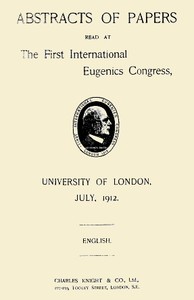
Abstracts of Papers Read at the First International Eugenics Congress University of London, July, 1912 — A Reader’s Guide
(0 User reviews)
96
Project Gutenberg
2014
Not confirmed
Eugenics -- Congresses
Readers of public-domain and historical texts
Project Gutenberg digital edition
en
Edition facts
Words
54,815
Reading time
239 min
Text sections
12
Before opening Abstracts of Papers Read at the First International Eugenics Congress University of London, July, 1912 — A Reader’s Guide, the edition data offers a quick orientation: 54,815 words, 3 hr 59 min estimated reading time, and 12 detected text sections.
The text analysis averages about 16.9 words per sentence, while the detected sections provide another way to judge how the source is divided.
Project Gutenberg metadata also associates the work with “Eugenics -- Congresses,” connecting these edition facts with the source record’s subject description.
Source:
Project Gutenberg record #44948
This collection of abstracts from the 1912 International Eugenics Congress reveals the early 20th-century scientific and social arguments for eugenics, with papers on biology, practical measures, sociology, and medicine. The excerpts show tensions between biological determinism and social explanations for phenomena like birth order effects and infant mortality.
Read the complete public-domain text at its original source.
Read on Project GutenbergThe First International Eugenics Congress, held at the University of London in July 1912, brought together biologists, sociologists, and medical professionals to present research on heredity, population quality, and social policy. This volume collects abstracts of those papers, offering a snapshot of the scientific and ideological foundations of the early eugenics movement. The excerpts reveal a field grappling with methodological challenges: researchers debate whether observed patterns—such as higher mortality among later-born children or myopia in first-borns—stem from biological inheritance or social conditions like family size and parental care.
Debating Birth Order and Mortality
The excerpts include detailed statistical analyses of birth order and child mortality, particularly from the work of Weinberg and Ploëtz. Weinberg’s data on 3,129 tuberculous and 1,830 non-tuberculous families in Stuttgart (1873–1889) show that later-born children have higher mortality before age 20, but he argues this is partly due to family size effects. When controlling for family size, the increase with birth order is smaller. Ploëtz’s study of princely families finds that seventh to ninth children have mortality rates similar to first-borns, suggesting that social factors—not biological laws—drive the pattern. The text explicitly states that “the increasing mortality of the later born children up to the tenth child is based on a biological law” is contradicted by this evidence.
Heredity versus Environment in Defects
Crzellitzer’s figure on myopia (extreme short-sightedness) illustrates a key tension: first-borns show higher rates of myopia, but only when there is a hereditary taint. In families without such taint, birth order makes no difference. The author concludes that “the disadvantage of the first born in respect of myopia is based on a greater hereditary taint and on no other factor.” This suggests that researchers were attempting to isolate genetic from environmental causes, even as they acknowledged that social class and parental age (fathers of first-borns tend to be older in well-to-do families) could confound results. The abstract thus reveals an early effort to apply Mendelian genetics to human traits while grappling with non-biological variables.
The Interval Between Births as a Key Variable
Dr. A. Bluhm’s analysis, citing Ansell and Westergaard, emphasizes that the interval between births has a “materially greater influence” than birth order or family size on infant mortality. Using data from the National Life Assurance Society of London, Ansell demonstrated that a child’s chance of surviving the first year improves with longer intervals between births. This finding shifts attention from inherent biological inferiority to maternal and infant care practices, suggesting that eugenic concerns might be addressed through social reforms rather than selective breeding. The abstract thus highlights a recurring theme: the difficulty of disentangling heredity from environment in early 20th-century eugenics research.
Readers approaching this volume should note that the abstracts are summaries, not full papers, and often omit methodological details. The excerpts show that even within the eugenics movement, there was debate over whether observed differences were due to heredity or social conditions. This makes the collection valuable not only as a historical document of scientific racism but also as a record of early attempts to apply statistical methods to human biology.
It’s strange to revisit these 1912 abstracts now and feel the quiet confidence of that era, so certain in its categories. That old belief in tidy solutions lingers in my memory like a fading photograph. I keep Social Civics — A Reader’s Guide nearby, as if that older vision of neighborliness might somehow balance the ledger of what was assumed.
There are no reviews for this eBook.
There are no comments for this eBook.
Reader reflection
What was your reading experience?
Capture what you thought, learned, and would like to remember.
Your progress
0
/
10
2
How did the book work for you overall?
3
Is this a title you would suggest to others?
4
How easy was the book to follow?
5
How would you describe its reading pace?
6
How clear did the writing feel?
7
Could you see yourself revisiting this book?
8
Would this book work well in a reading group?
9
What changed or sharpened your thinking?
10