1

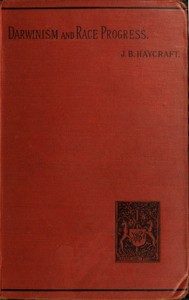
Darwinism and Race Progress — A Closer Reading
(0 User reviews)
260
Project Gutenberg
2014
Not confirmed
Sociology; Evolution
Readers of public-domain and historical texts
Project Gutenberg digital edition
en
Edition facts
Words
46,004
Reading time
201 min
Text sections
8
Darwinism and Race Progress — A Closer Reading can be approached with a clearer sense of reading commitment from its source measurements: 46,004 words, 3 hr 21 min estimated reading time, and 8 detected text sections.
The text analysis averages about 28.1 words per sentence, while the detected sections provide another way to judge how the source is divided.
Project Gutenberg metadata also associates the work with “Sociology,” connecting these edition facts with the source record’s subject description.
Source:
Project Gutenberg record #45992
John Berry Haycraft's 1895 work applies Darwinian selection to human society, arguing that modern philanthropy may inadvertently cause racial decline. The text blends physiology, sociology, and polemic, using a clinical tone to advocate for harsh poor-law reforms.
Read the complete public-domain text at its original source.
Read on Project GutenbergJohn Berry Haycraft opens Darwinism and Race Progress with a physician's confidence, declaring that muscle and brain, not political organisation, determine a race's fate. The book, expanded from his 1894 Milroy Lectures, addresses a non-specialist audience but retains a technical edge. Haycraft immediately challenges the assumption that racial decay is inevitable, pointing to the persistence of Scandinavian and Jewish types as counterexamples. His argument hinges on the idea that modern philanthropy, however well-intentioned, may be selecting for weakness—a theme he pursues with relentless logic.
A Physician's Lens on Social Ills
Haycraft approaches poverty and poor laws as a clinician would a patient. He faults lawyers and lawmakers for their superficial remedies, arguing that the physician's method—studying each case with its peculiar symptoms—would serve better. This medical framing pervades the text, lending authority to his prescriptions. He cites the 1834 Poor Law Commissioners' Report, quoting a witness who observed that the independent labourer fared worst of all. The passage reveals Haycraft's reliance on empirical evidence, though his conclusions are sharply ideological.
His diagnosis: the poor laws have bred a want of independence, especially in rural districts. Those who might otherwise strive for self-sufficiency instead fall back on relief, knowing the workhouse door is open. Haycraft's language is blunt, almost surgical, as he dissects what he sees as the moral hazards of charity.
Selection, Heredity, and the Limits of Reform
The book's biological core draws on Darwin, Lamarck, Galton, and Weismann. Haycraft weighs the evidence for transmission of acquired characters, concluding that reproductive cells are largely insulated from local bodily changes. This technical discussion grounds his social argument: if acquired traits are not inherited, then improving conditions for individuals does not necessarily improve the race. He warns that modern preventive medicine, by keeping the weak alive, may interfere with natural selection.
Haycraft's tone here is measured, but his implications are stark. He presents selection as a fact, not a theory, and insists that breeders and gardeners have long understood its power. The reader is left to infer that human society, too, must reckon with these laws—or face decline.
The Idle and Vicious as Subjects for Criminal Law
In his most provocative section, Haycraft argues that the able-bodied poor who refuse work should be treated under criminal law, not poor relief. He contends that the prison cell is warmer than a primitive Briton's rock cranny, and prison fare better than his food—so why should the idle vagabond enjoy the fruits of civilisation without contributing? The passage is deliberately jarring, using historical comparison to strip away sentimentality.
Haycraft does not mince words: the lazy and vicious have profited from organised charity meant for the sickly and aged. He calls for their segregation, with the goal of reclamation but the immediate effect of punishment. The moral atmosphere of the poorhouse, he argues, would be purged by their exclusion. This section crystallises the book's central tension between individual compassion and racial imperatives.
Haycraft's prose is that of a controversialist who believes he has science on his side. Readers should attend to how he moves between biological principle and social policy, noting where evidence supports his claims and where rhetoric fills gaps. The book is a document of its time, but its questions—about the unintended consequences of benevolence and the tension between individual and collective welfare—remain provocative.
There’s something sobering about rereading Haycraft’s clinical prose—his worry that kindness might carry a hidden cost. It lingers oddly, even now. When I later picked up The city — Edition Insights, I found that same weight, that same quiet question about who we are together. Different streets, same shadow, maybe. Just an old thought returning.
There are no reviews for this eBook.
There are no comments for this eBook.
Reader reflection
What was your reading experience?
Capture what you thought, learned, and would like to remember.
Your progress
0
/
10
2
Was reading this book enjoyable?
3
Would you pass this book on to a friend?
4
Did the language feel accessible?
5
How would you rate its originality?
6
Did the book meet your expectations?
7
What was its emotional impact?
8
Is this a title worth rereading?
9
In one sentence, what did you learn?
10