1

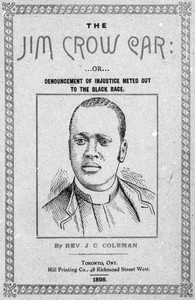
The Jim Crow Car; Or, Denouncement of injustice meted out to the black race — Key Ideas to Explore
(0 User reviews)
239
Project Gutenberg
2020
Not confirmed
African Americans -- Civil rights; Southern States -- Race relations; Racism -- Southern States
Readers of public-domain and historical texts
Project Gutenberg digital edition
en
Edition facts
Words
33,267
Reading time
145 min
Text sections
4
The catalog record for The Jim Crow Car; Or, Denouncement of injustice meted out to the black race — Key Ideas to Explore provides practical reading context through 33,267 words, 2 hr 25 min estimated reading time, and 4 detected text sections.
The text analysis averages about 24.0 words per sentence, while the detected sections provide another way to judge how the source is divided.
Project Gutenberg metadata also associates the work with “African Americans -- Civil rights,” connecting these edition facts with the source record’s subject description.
Source:
Project Gutenberg record #62741
A 1898 polemic by Rev. J. C. Coleman that combines personal railroad anecdotes, legal analysis, and quoted testimony to denounce Jim Crow segregation and racial injustice in the post-Reconstruction South.
Read the complete public-domain text at its original source.
Read on Project GutenbergRev. J. C. Coleman opens The Jim Crow Car by grounding his protest in eight years of touring the South as an illustrated lecturer. The preface immediately establishes a hybrid mode: personal incident, legal argument, and quoted testimony from figures such as Bishop H. M. Turner and Ida B. Wells-Barnett. Coleman frames the book as a response to requests from Northern and Canadian audiences for a more detailed account of “Southern horrors,” and he insists his statements are “authentic and impartial.” The work thus moves between first-person narrative of railroad encounters and extended passages of constitutional reasoning, creating a distinctive rhythm of outrage and legal precision.
A Voice of Witness and Citation
The excerpts show Coleman weaving quoted material into his own prose without always marking the transition. For instance, a long passage from a Supreme Court dissent appears without introductory framing, its dense legal language contrasting sharply with the more direct, aggrieved tone of the preface. This juxtaposition suggests that Coleman sees legal reasoning and personal testimony as equally valid forms of evidence. The effect is a text that demands attention to its sources: the reader must track who is speaking at any given moment, a task that mirrors the work’s broader concern with whose testimony is believed and whose is dismissed.
The Rhetoric of the Rape Accusation
The passage is notable for its brevity and force. Coleman does not linger on graphic detail; instead, he lets the question stand as a logical trap. The surrounding context—a discussion of how slavery denied literacy and basic humanity—reinforces his argument that the post-emancipation wave of rape accusations is a political tool rather than a reflection of actual crime. By isolating the accusation and subjecting it to historical scrutiny, Coleman attempts to reclaim the terms of the debate from the Southern press, which he accuses of having “made scores of enemies for the entire race.”
Pacing and the Interruption of Legal Prose
This abrupt change in pace can disorient a reader expecting continuous narrative. Yet it also mirrors Coleman’s method: he juxtaposes the visceral reality of Jim Crow cars with the abstract language of the law that was supposed to prevent them. The legal sections are not digressions but structural counterpoints. They slow the reader down, forcing a confrontation with the gap between constitutional promise and lived experience. The effect is cumulative: the personal outrage of the preface gains weight when followed by the cold, reasoned language of the courts, which itself becomes a kind of evidence of failure.
Readers approaching The Jim Crow Car should be prepared for a text that shifts registers without warning. Coleman expects his audience to follow legal arguments as closely as personal anecdotes, and he trusts that the juxtaposition will produce its own indictment. The book is best read as a composite document—part memoir, part legal brief, part anthology of protest—rather than a single sustained argument. Pay attention to the sources Coleman chooses to amplify, and to the moments when his own voice re-emerges after pages of quoted text. Those returns often carry the greatest emotional weight.
Years ago, I shelved Reverend Coleman’s fierce little book, and its righteous anger still hums in my memory. There’s a quieter, older ache in Profile in black and white — Context and Discussion, which reads like the slow, considered exhale after that long-denied breath. Side by side, they whisper the same truth—one shouting, one remembering—and I hold them both close.
There are no reviews for this eBook.
There are no comments for this eBook.
Reader reflection
What did you think of this book?
Answer a few questions and save a private reflection on this device.
Your progress
0
/
10
2
How did the book work for you overall?
3
Is this a title you would suggest to others?
4
How demanding did the text feel?
5
How would you rate its originality?
6
Could you apply anything you learned?
7
Did any part of the book feel personally relevant?
8
Would a second reading be valuable?
9
What is the main idea you are taking away?
10