1

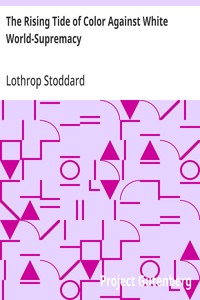
The Rising Tide of Color Against White World-Supremacy — Text and Context
(0 User reviews)
859
Project Gutenberg
2011
Not confirmed
Race relations; Caucasian race
Readers of public-domain and historical texts
Project Gutenberg digital edition
en
Edition facts
Words
85,670
Reading time
373 min
Text sections
13
For The Rising Tide of Color Against White World-Supremacy — Text and Context, the stored edition analysis reports 85,670 words, 6 hr 13 min estimated reading time, and 13 detected text sections.
The text analysis averages about 21.1 words per sentence, while the detected sections provide another way to judge how the source is divided.
Project Gutenberg metadata also associates the work with “Race relations,” connecting these edition facts with the source record’s subject description.
Source:
Project Gutenberg record #37408
Lothrop Stoddard's 1920 work argues that race conflict, not class struggle, will define the 20th century. The preface frames World War I as a 'White Civil War' weakening global white dominance, while later excerpts detail a 'disgenic' trend among Nordics under industrialism. The text blends geopolitical analysis with eugenic theory.
Read the complete public-domain text at its original source.
Read on Project GutenbergLothrop Stoddard's preface, dated June 1914, declares that 'the relations between the primary races of mankind' would be the key-note of twentieth-century world-politics. He then reinterprets the Great War as a 'White Civil War,' arguing it gravely complicated racial relations by weakening the white world's 'inherent strength and fundamental solidarity.' This framing sets the book's central argument: that the war opened 'revolutionary, even cataclysmic, possibilities' for the colored peoples.
Stoddard's language is precise and alarmist, using terms like 'renascence of the brown and yellow peoples' and 'subjugation of white lands by colored armies.' The preface establishes a global, evolutionary perspective, warning that the quality of human life depends on the character of racial readjustments.
A Global Framework from the Preface
The preface, written before the war's end, reveals Stoddard's long-held conviction that race relations would dominate the century. He references his 1914 monograph on San Domingo, where he first called the 'conflict of color' the fundamental problem. The preface's key move is to reinterpret the Great War not as a clash of nations but as a civil war within the white race, which 'must gravely complicate the course of racial relations.' Stoddard explicitly rejects the idea that the war diminished the importance of race; instead, he argues it heightened it. He warns that the white world's 'frightful weakening' could lead to 'cataclysmic possibilities,' though he does not specify military conquest alone. The preface thus orients the reader toward a global, evolutionary struggle where the white race's internal divisions are the primary threat to its dominance.
The Disgenic Trend Among Nordics
In a later excerpt, Stoddard introduces a 'disgenic' trend: the better types (Nordics) are numerically stationary or dwindling, while lower types gain ground. He divides the white race into three sub-species—Nordics, Alpines, and Mediterraneans—and asserts that the Nordic is 'far and away the most valuable type,' standing 'at the head of the whole human genus.' The industrial revolution, he claims, disproportionately harms Nordics, who require 'healthful living conditions' and 'good food, fresh air, and exercise.' In contrast, the 'little brunet Mediterranean' adapts to factory and clerical work, prospers, and reproduces. Stoddard also notes that before industrialization, war was the Nordic's chief eliminator, as their fighting ability and leadership exposed them to greater losses. The excerpt thus combines eugenic hierarchy with environmental determinism, arguing that modern urban conditions reverse the Nordic's demographic advantage.
Historical Depletion and the Role of Migration
Stoddard traces the Nordic decline to earlier historical processes. He notes that even by the end of the eighteenth century, Europe was 'much less Nordic than it had been a thousand years before.' The causes were war and migration: adventurous Nordics formed the 'overwhelming majority of explorers and pioneers' to new lands, further depleting the European stock. However, he also acknowledges that down to the close of the eighteenth century, Nordics enjoyed advantages: in cool northern and central Europe, environment favored them, and in the hotter south, they survived as an aristocracy protected from field labor. The industrial revolution, however, 'profoundly modified this state of things,' transforming Europe into an urbanized, industrial area where 'the cramped factory and the crowded city weeded out the big, blond Nordic with portentous rapidity.' This section shows Stoddard's attempt to synthesize historical demography with racial theory, though the evidence is asserted rather than demonstrated.
Reading the Book's Structure and Argument
The excerpts suggest a two-part structure: first, a global geopolitical analysis of race relations (preface and likely early chapters), then a domestic focus on white racial health (later excerpts). Stoddard's argument relies on a hierarchy of races, with Nordics at the top, and on the claim that industrial civilization is dysgenic for the most valuable stock. Readers should note that Stoddard uses terms like 'primary races' and 'sub-species' without clear biological definition, and his evidence is largely anecdotal or asserted. The book's tone is urgent and declarative, with frequent use of 'evidently' and 'of course.' The preface's framing of World War I as a 'White Civil War' is central to understanding the book's thesis: that the war's main consequence was to weaken white supremacy, not to resolve European conflicts. The later excerpts on disgenics extend this argument to internal demographic threats.
The excerpts reveal a work that blends geopolitical prophecy with eugenic alarmism. Stoddard's central claim—that the Great War was a 'White Civil War'—shapes every subsequent argument. Readers should attend to how he moves from global to national scales, and how he uses terms like 'Nordic' and 'disgenic' to link race, environment, and history. The book is less a scientific treatise than a polemic, and its value lies in understanding the anxieties of its era.
That rain-soaked afternoon, Stoddard’s warnings about civilizational fatigue sat heavy in my lap, his race-fears feeling ancient yet uncomfortably familiar. I closed the book mostly to escape it, and on the shelf, my hand drifted to Wells instead—a quieter faith in human will, less bleak, more curious. The open conspiracy — Themes and Context felt like a door left ajar in that storm.
There are no reviews for this eBook.
There are no comments for this eBook.
Reader reflection
Take a moment to reflect on this book
Create a short personal record of your experience with this book.
Your progress
0
/
10
2
What was your overall reaction to the book?
3
Would you recommend this book to another reader?
4
Did the language feel accessible?
5
Did the book meet your expectations?
6
Did any part of the book feel personally relevant?
7
How valuable was this book for your own interests?
8
How original did the book feel?
9
What did this book teach you most?
10