1

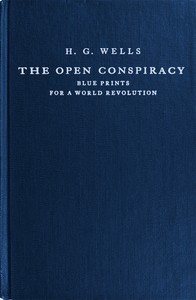
The open conspiracy — Themes and Context
(0 User reviews)
189
Project Gutenberg
2025
Not confirmed
Sociology; Utopias; Social problems
Readers of public-domain and historical texts
Project Gutenberg digital edition
en
Edition facts
Words
39,185
Reading time
171 min
Text sections
23
This digital edition of The open conspiracy — Themes and Context is described by source-level measurements including 39,185 words, 2 hr 51 min estimated reading time, and 23 detected text sections.
The text analysis averages about 28.4 words per sentence, while the detected sections provide another way to judge how the source is divided.
Project Gutenberg metadata also associates the work with “Sociology,” connecting these edition facts with the source record’s subject description.
Source:
Project Gutenberg record #75786
H.G. Wells presents a personal manifesto for global transformation, arguing that humanity must consciously organize to overcome national divisions, economic exploitation, and cultural inertia. Drawing on his earlier works, he outlines a 'religion' of collective responsibility and a practical scheme for a world revolution.
Read the complete public-domain text at its original source.
Read on Project GutenbergIn The Open Conspiracy, H. G. Wells strips his worldview to its foundations, declaring the book his religion and the directive aim of all his work. He does not offer a utopian blueprint but a scheme for human conduct, a fight against frustration and death. Wells insists that the scale of the subject—the whole destiny of man—is no more pretentious than studying a muscle fibre; it is a matter of method, not hierarchy. He confronts the reader with a stark choice: organize along the lines he draws or face degradation. The tone is urgent, personal, and unapologetically ambitious.
A Religion Without Supernatural Claims
Wells frames his project as a religion, but one stripped of dogma. In the preface, he writes, “This is my religion. Here are my directive aims and the criteria of all I do.” He does not invoke deities or revelation; instead, he grounds his faith in observable human potential and the accident of a great opportunity. The Open Conspiracy is a creed of action, not contemplation. Wells challenges readers to test his principles against their own lives, inviting correction and debate. This secular, pragmatic religiosity sets the work apart from both traditional faiths and political ideologies, which he later critiques as crystallized or dogmatic.
Geopolitical Obstacles to the Conspiracy
Wells surveys the world’s regions as fields of resistance. He describes India as a “world in itself,” pickled by British rule, where the Open Conspiracy must breach the prejudices of both ruler and governed. He envisions individual breaches—a genuine educationist, a creative civil servant—linked with native scholars and princes. Similarly, he sees French possessions in North Africa and Syria as areas of restraint, breeding low-grade populations and cheap labor. The negro world and jungle regions, he argues, will be absorbed by modern communication and tropical disease control, destroying the material basis of barbaric life. These passages reveal Wells’s global, systemic thinking, but also his era’s assumptions about progress and civilization.
The Tone of Urgency and Self-Justification
Wells’s prose is marked by a defensive yet fervent tone. He anticipates the charge of pretension and counters it with a leveling argument: mapping a continent is not inherently superior to examining a muscle fibre. He repeatedly insists that his scheme is tentative, full of faults and gaps, yet he also declares it “the truth and the way of salvation.” This tension between humility and grandiosity runs through the excerpts. Wells prays the reader for a hearing, but his language is commanding: “I bear my witness and argue my design.” The reader is addressed as a potential convert or critic, not a passive audience. This rhetorical stance shapes the entire work.
Readers should approach The Open Conspiracy as a document of its time—a synthesis of early twentieth-century anxieties about progress, empire, and human agency. Wells’s global survey, from India to the negro world, reflects both his analytical ambition and the limits of his perspective. The book rewards attention to its structural choices: the personal preface, the geopolitical tour, the recurring contrast between crystallized ideologies and fluid conspiracy. It is less a finished program than an invitation to think on the scale of the species.
That rainy afternoon, Wells’s Open Conspiracy felt less like a plan than a plea—for us to outgrow our tribal reflexes. Closing it, my gaze wandered to the shelf, to a sturdier, older spine. The tide of color he half-foresaw had already risen in The Rising Tide of Color Against White World-Supremacy — Text and Context, a sobering undertow beneath his hopeful globalism, and I sat with both until the light failed.
There are no reviews for this eBook.
There are no comments for this eBook.
Reader reflection
What did you think of this book?
Answer a few questions and save a private reflection on this device.
Your progress
0
/
10
2
How did the book work for you overall?
3
Would you recommend this book to another reader?
4
How demanding did the text feel?
5
Did any part of the book feel personally relevant?
6
Did you gain anything practical from the text?
7
Is this a title worth rereading?
8
Was the book what you thought it would be?
9
What is the main idea you are taking away?
10