1

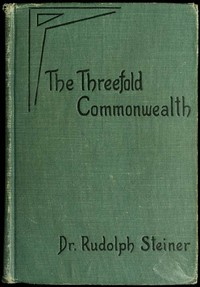
The Threefold Commonwealth — Reading Companion
(0 User reviews)
605
Project Gutenberg
2019
Not confirmed
Social sciences -- Miscellanea
Readers of public-domain and historical texts
Project Gutenberg digital edition
en
Edition facts
Words
45,510
Reading time
198 min
Text sections
7
The catalog record for The Threefold Commonwealth — Reading Companion provides practical reading context through 45,510 words, 3 hr 18 min estimated reading time, and 7 detected text sections.
The text analysis averages about 29.4 words per sentence, while the detected sections provide another way to judge how the source is divided.
Project Gutenberg metadata also associates the work with “Social sciences -- Miscellanea,” connecting these edition facts with the source record’s subject description.
Source:
Project Gutenberg record #59257
Rudolf Steiner argues that modern society must separate into three independent spheres—political, economic, and spiritual—to resolve social crises. Drawing on the French Revolution's ideals of liberty, equality, and fraternity, he contends that these principles can only be realized through a threefold social order, not a unified state.
Read the complete public-domain text at its original source.
Read on Project GutenbergRudolf Steiner opens The Threefold Commonwealth by insisting that the social problems of the present day demand solutions along paths “unthought-of hitherto.” He grounds his argument in the conviction that ignoring the actual facts of modern life—especially the demands of the working class—has led to confusion and perplexity. The book is not a detached theoretical treatise but a response to urgent, concrete social movements. Steiner warns that those who consider themselves “experts in practical life” will be displeased by his remarks, signaling that his proposals challenge conventional notions of practicality.
The Three Spheres as Living Reality
Steiner’s central claim is that a healthy society must separate into three distinct, self-governing spheres: the political (rights), the economic, and the spiritual (cultural). He insists that these are not artificial divisions but correspond to three “distinct sources” that have always existed, though previously they worked together in a “dim and dully conscious” manner. Modern humanity, he argues, now demands conscious cooperation, and this new social consciousness “must be directed from three aspects.” The unity of the social organism emerges not from centralization but from the interplay of these independent branches, each centered in itself.
Fraternity, Equality, Liberty Reinterpreted
Steiner directly engages with the French Revolution’s triad of fraternity, equality, and liberty. He acknowledges that keen thinkers of the nineteenth century demonstrated the impossibility of realizing all three within a homogeneous social order—for instance, equality would seem to contradict freedom. Yet Steiner argues that these ideals only appear contradictory until one perceives the necessity of a threefold order. In his framework, each principle finds its proper home in one sphere: fraternity in economic life, equality in political rights, and liberty in spiritual culture. The apparent contradictions become complementary when each sphere operates autonomously.
The Spiritual Sphere as Independent Source
Steiner places particular emphasis on the spiritual sphere—encompassing ideas, organizing capacities, and cultural life—as an independent, self-governing domain. He writes that from the spiritual life originate “all those ideas and organising capacities that enrich the life of the State and of industrial economy.” Unlike the other spheres, the spiritual sphere’s recompense is raised through voluntary recognition or through rights built up in the political sphere. Steiner’s vision thus grants cultural and intellectual life a foundational role, separate from both state power and economic forces, and warns against subordinating it to either.
Readers approaching The Threefold Commonwealth should attend to Steiner’s repeated insistence that his proposals are not abstract ideals but responses to observable social facts. He grounds his argument in the tensions between liberty, equality, and fraternity, and in the failure of uniform social orders to reconcile them. The excerpts do not reveal how Steiner would implement this threefold separation in practice, but they make clear that he sees it as an evolutionary necessity, not a utopian scheme.
Sometimes I reread the French Revolution’s ideals and think how quietly they’ve aged, then remember Steiner’s insistence that liberty, equality, fraternity can’t live under one roof. That ache for balance carries into Human nature and the social order — Inside the Classic, where the same unease about fitting our whole selves into one system lingers, almost like an old friend’s hand on my shoulder.
There are no reviews for this eBook.
There are no comments for this eBook.
Reader reflection
How will you remember this book?
Save your reaction, strongest insight, and memorable passage.
Your progress
0
/
10
2
How did the book work for you overall?
3
Would you encourage someone else to read it?
4
How easy was the book to follow?
5
Did you relate to its people, ideas, or situations?
6
How much did the book move you?
7
Did the story or argument move comfortably?
8
How useful were the ideas in this book?
9
What is the main idea you are taking away?
10