1

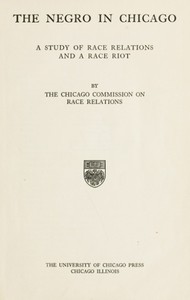
The Negro in Chicago: A Study of Race Relations and a Race Riot — Context and Discussion
(0 User reviews)
741
Project Gutenberg
2018
Not confirmed
African Americans -- Illinois -- Chicago; Chicago Race Riot, Chicago, Ill., 1919; Chicago (Ill.) -- History -- 1875-; Chicago (Ill.) -- Race relations
Readers of public-domain and historical texts
Project Gutenberg digital edition
en
Edition facts
Words
342,048
Reading time
1488 min
Text sections
59
For The Negro in Chicago: A Study of Race Relations and a Race Riot — Context and Discussion, the stored edition analysis reports 342,048 words, 24 hr 48 min estimated reading time, and 59 detected text sections.
The text analysis averages about 20.8 words per sentence, while the detected sections provide another way to judge how the source is divided.
Project Gutenberg metadata also associates the work with “African Americans -- Illinois -- Chicago,” connecting these edition facts with the source record’s subject description.
Source:
Project Gutenberg record #57343
A 1922 commission report on the 1919 Chicago race riot, combining narrative of the violence with statistical analysis of housing, employment, and courts. The excerpts show a document that is part sociological study, part official record, with careful attention to data and testimony.
Read the complete public-domain text at its original source.
Read on Project GutenbergThe Chicago Commission on Race Relations produced this 1922 report as an official investigation of the July 1919 riot, but the excerpts reveal a work that is as much a sociological survey as a historical account. The table of contents lists chapters on the riot itself, other outbreaks, and the migration of Negroes from the South, but the text also includes detailed statistical tables on housing, employment, and court cases. The report's voice is bureaucratic and data-driven, yet it incorporates direct testimony from witnesses and officials, such as juvenile court officers who describe differences in education and environment between northern and southern Negro delinquents.
A Commission's Dual Purpose
The catalog subjects list the Chicago Race Riot of 1919 and African Americans in Chicago, but the excerpts show the report is not merely a narrative of the riot. The table of contents includes chapters on the migration of Negroes from the South and on housing and employment, indicating a broader study of race relations. The commission's method is evident in the court data: 703 cases were studied, 538 white and 165 Negro, with social histories showing that more than half of Negro arrestees left school before age twelve. The report uses statistics to argue that environmental factors, not inherent differences, explain crime rates. One judge was observed shaking dice during a hearing, a detail that underscores the report's willingness to document official misconduct.
Testimony as Evidence
The excerpts include direct quotes from officials like Miss Mary Bartelme, who said of Negro girls from the South: "Their education has not been equal to the education of white girls." Joseph L. Moss, chief probation officer, noted that southern Negro delinquents often committed misdemeanors rather than serious offenses, which he attributed to "the difference in standards between former environment and the present one." These statements are presented as evidence, not as the commission's own conclusions. The report also records that Miss Bartelme said offenses of white and colored girls were "very much the same." This reliance on testimony gives the document a layered quality, where official voices sometimes contradict each other.
The Riot's Beginning and the Role of Rumor
The chapter on the riot begins with the drowning of Eugene Williams at the Twenty-ninth Street beach, an event that sparked the violence. The table of contents lists sections on "Rumor" and "Gangs and 'Athletic Clubs,'" suggesting the commission analyzed how false stories and organized groups amplified the conflict. The excerpts do not provide the full narrative, but the structure implies a methodical breakdown of causes. The report also includes a map and illustrations, such as a photograph of whites and Negroes leaving the beach after the drowning. This visual evidence, combined with the chronological story, shows the commission's effort to create an authoritative record of the riot's progression.
Readers should approach this report as a primary source that reveals how an official body in 1922 understood and documented racial conflict. The excerpts show a work that is both a historical record and a sociological argument, using statistics and testimony to challenge assumptions about race and crime. The report's value lies not only in its account of the riot but in its detailed picture of Chicago's racial landscape in the early twentieth century.
Reading the Chicago report, I remembered my grandfather’s quiet stories about moving north, the way he’d pause on certain words. That careful tallying of lives felt familiar, like the layered testimony in Profile in black and white — Context and Discussion. Both books hum with the same ache—how measured facts can’t quite hold the heat of what people endured.
There are no reviews for this eBook.
There are no comments for this eBook.
Reader reflection
What did you think of this book?
Answer a few questions and save a private reflection on this device.
Your progress
0
/
10
2
How did the book work for you overall?
3
Would you recommend this book to another reader?
4
Did the language feel accessible?
5
How valuable was this book for your own interests?
6
How personally connected did you feel to the book?
7
Was the book moving at the right speed?
8
Which element worked best for you?
9
Which lesson or insight stayed with you?
10