1

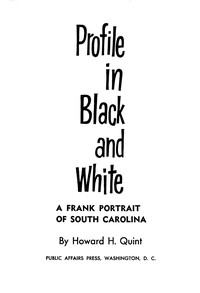
Profile in black and white — Context and Discussion
(0 User reviews)
211
Project Gutenberg
2023
Not confirmed
African Americans -- South Carolina; South Carolina -- Race relations; Segregation -- South Carolina; Segregation in education -- South Carolina
Readers of public-domain and historical texts
Project Gutenberg digital edition
en
Edition facts
Words
93,882
Reading time
409 min
Text sections
23
The source record for Profile in black and white — Context and Discussion measures this digital text at 93,882 words, 6 hr 49 min estimated reading time, and 23 detected text sections.
The text analysis averages about 16.5 words per sentence, while the detected sections provide another way to judge how the source is divided.
Project Gutenberg metadata also associates the work with “African Americans -- South Carolina,” connecting these edition facts with the source record’s subject description.
Source:
Project Gutenberg record #71378
An examination of South Carolina's resistance to desegregation after the 1954 Supreme Court decision, focusing on political rhetoric, legislative maneuvers, and press reactions through primary sources.
Read the complete public-domain text at its original source.
Read on Project GutenbergHoward H. Quint's Profile in Black and White opens with a blunt assessment: South Carolina's racial situation had not materially improved after the Supreme Court's 1954 desegregation ruling. The book builds its case through a dense array of official documents, newspaper editorials, and legislative records, letting the state's own words—from interposition resolutions to fiery floor speeches—illustrate the depth of organized opposition. Quint, a University of South Carolina historian who resigned rather than risk embarrassing his employer, maintains a restrained tone even as he catalogs the tactics used to evade federal law.
The Language of Interposition
The book devotes considerable attention to the 1956 Timmerman resolution, a legislative document that stopped short of outright nullification but declared the Supreme Court's decision "a deliberate, palpable, and dangerous attempt to change the true intent and meaning of the Constitution." Quint traces how the resolution's careful wording—calling itself a "protest" rather than "interposition"—drew criticism from both sides. Fire-eaters like Representative George Harrell wanted a stronger statement declaring the decision "null and void," while moderates praised the resolution as a "dignified document." The press coverage Quint assembles reveals a state arguing with itself over how far to push constitutional defiance.
Newspapers as Battlefields
Quint repeatedly turns to newspaper columns to show how editorial pages shaped public opinion. The News and Courier of Charleston, for instance, is cited urging a positive assertion of state authority. W. D. Workman Jr., a political writer, called the Timmerman resolution "well-worded, well-reasoned and eminently logical" but lamented that it stopped at the threshold of interposition. The upcountry Independent dismissed the resolution as meaningless protest, while the Record condemned "all-powerful central government" and linked Northern urban politics to a supposed erosion of minority rights. These contrasting voices give the book a layered sense of internal disagreement.
The Echoes of Nullification
Quint draws a direct line from South Carolina's antebellum nullification crisis to the 1950s resistance. The introduction asks pointedly: "When it revives the plea of peculiarity does it remember its own history of nullification and secession?" This historical framing recurs as legislators invoke states' rights language nearly identical to that of the 1830s. The book does not need to spell out the parallel; the documents themselves echo earlier constitutional arguments. Quint's method is to let the record show how the state's political class reached for old legal tools to meet a new federal mandate.
The Author's Position and Method
Quint's own biography becomes part of the book's evidence. The author note explains that he resigned from the University of South Carolina to avoid embarrassing a state-supported institution—a fact that underscores the pressure surrounding the topic. His approach is documentary: he cites speeches, resolutions, and editorials at length, organizing them by theme rather than chronology. The excerpts show a writer who lets his sources speak, intervening only with brief analytical comments. This restraint gives the book the feel of a primary-source reader, though Quint's selection and framing inevitably shape the portrait that emerges.
Readers should approach Profile in Black and White as a contemporary document as much as a historical study. Quint's decision to foreground official statements and press reactions means the book captures the public face of segregationist politics in the mid-1950s. The absence of extensive firsthand testimony from African Americans is a limitation worth noting; the profile is drawn largely from the white power structure's own records. For those interested in the mechanics of resistance—the legal arguments, the legislative tactics, the editorial strategies—this remains a concentrated source.
I kept thinking about how quietly a society can choose its own story, the way South Carolina’s leaders framed defiance as something noble. It reminded me of another book I once sat with, The Non-religion of the Future: A Sociological Study — Reading Notes, where the same bittersweet pattern appears—how belief systems shift not with thunder, but with a thousand small, human choices. Both left me staring out a window, feeling the weight of that.
There are no reviews for this eBook.
There are no comments for this eBook.
Reader reflection
How will you remember this book?
Save your reaction, strongest insight, and memorable passage.
Your progress
0
/
10
2
What was your overall reaction to the book?
3
Is this a title you would suggest to others?
4
How demanding did the text feel?
5
How original did the book feel?
6
What was its emotional impact?
7
How clear did the writing feel?
8
Do you expect to return to this book?
9
In one sentence, what did you learn?
10