1

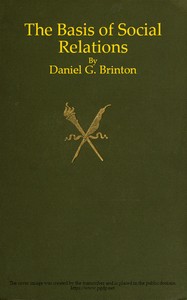
The Basis of Social Relations: A Study in Ethnic Psychology — Inside the Classic
(0 User reviews)
719
Project Gutenberg
2020
Not confirmed
Sociology; Ethnopsychology
Readers of public-domain and historical texts
Project Gutenberg digital edition
en
Edition facts
Words
48,266
Reading time
210 min
Text sections
14
Before opening The Basis of Social Relations: A Study in Ethnic Psychology — Inside the Classic, the edition data offers a quick orientation: 48,266 words, 3 hr 30 min estimated reading time, and 14 detected text sections.
The text analysis averages about 22.1 words per sentence, while the detected sections provide another way to judge how the source is divided.
Project Gutenberg metadata also associates the work with “Sociology,” connecting these edition facts with the source record’s subject description.
Source:
Project Gutenberg record #62259
An editorial note on Daniel G. Brinton's posthumous work, examining how its opening, middle, and later excerpts guide a first reading of this study in ethnic psychology.
Read the complete public-domain text at its original source.
Read on Project GutenbergDaniel G. Brinton's The Basis of Social Relations, published posthumously in 1902 with editing by Livingston Farrand, opens with a clear statement of its aim: to examine the psychological foundations of human society. The editor's preface notes that Brinton left the manuscript 'in a state of approximate completion,' lacking only final revision. This context is important for readers, as the text may reflect unfinished nuances. The work belongs to 'The Science Series,' edited by J. McKeen Cattell and F. E. Beddard, placing it alongside contemporary scientific works. Brinton, known for his contributions to American archaeology and linguistics, here turns to a broader theoretical project: arguing for the 'psychological unity of man,' a principle he actively championed.
The Opening: A Framework for Ethnic Psychology
The opening chapters establish Brinton's core argument: that social relations are rooted in shared psychological traits. He introduces the concept of 'ethnic psychology' as a discipline that studies the mental characteristics of groups. The excerpts show him distinguishing between 'intellectual deficiency' and 'intellectual perversion,' using examples from 'savages' and 'civilised communities.' Brinton's voice is clinical, drawing on contemporary anthropology and criminology. He cites Horatio Hale's observations of Australian aborigines, noting their 'great natural obtuseness, downright childishness, and imbecility'—a phrasing that reflects the racial hierarchies of his era. Readers should note how Brinton uses such evidence to support his thesis about group mental traits, while also acknowledging environmental factors like 'semi-starvation and malnutrition.'
Middle Excerpts: Categories of Mental Deficiency
In the middle of the work, Brinton categorizes forms of intellectual deficiency: imbecility, criminality, and perversion. He argues that some groups exhibit 'a prevailing inability to judge of evidence,' mistaking 'associations of time and place for relations of cause and effect.' This, he claims, fosters superstition. His discussion of criminality is particularly detailed: he distinguishes 'ordinary criminals' from reformers or martyrs, and cites Quetelet's view that 'society creates the germs of all crimes.' Brinton's language is deterministic, describing criminals as 'pathological, rapidly approaching a self-destructive degree of degeneration.' These passages reveal his reliance on late-19th-century criminological theories. Readers should observe how Brinton moves between individual psychology and group traits, often blurring the line between description and judgment.
Later Excerpts: The Argument for Psychological Unity
Later sections of the book return to Brinton's central doctrine: the psychological unity of mankind. Despite his earlier catalog of deficiencies, he insists that all human groups share a common mental foundation. The excerpts show him arguing that differences are due to 'conditions' rather than innate capacity. He writes that 'the most favoured race would, by similar conditions, be reduced to the same low intellectual stage.' This claim is crucial for understanding his overall project: Brinton seeks to reconcile hierarchical observations with a universalist framework. Readers should note how he uses examples from 'savages' and 'the illiterate classes of higher culture' to illustrate points, often without clear evidence. The text's structure suggests a work in progress, with some sections feeling less developed than others.
Structure and Voice: A Posthumous Work
The book's structure reflects its posthumous editing. Farrand's preface notes that he made 'verbal corrections' and 'slight rearrangement of certain sections to conform to the obvious scheme of the work.' This means readers encounter a text that may not fully represent Brinton's final intentions. The voice is authoritative and encyclopedic, with frequent references to contemporary scholars like Quetelet and Hale. Brinton's prose is dense, often mixing clinical observation with moral judgment. For example, he describes 'cranks' and 'eccentrics' as examples of 'intellectual perversion.' The absence of a conclusion or final revision leaves some arguments hanging. Readers should approach the text as a snapshot of late-19th-century anthropological thought, shaped by both Brinton's expertise and the editorial process.
Reading The Basis of Social Relations requires attention to its historical context and editorial history. Brinton's arguments about ethnic psychology reflect the assumptions of his time, including racial hierarchies and deterministic views of crime. Yet his commitment to psychological unity offers a counterpoint. The excerpts provide a window into his method: drawing on anecdotal evidence, citing authorities, and building a theoretical framework. For a first reading, focus on how Brinton defines key terms like 'ethnic psychology' and 'intellectual deficiency,' and note where his evidence supports or undermines his claims. The book rewards careful reading but demands critical engagement with its premises.
Brinton’s careful mapping of unseen bonds always puts me in mind of another quiet volume, one that muses on will and shared purpose without ever raising its voice. They are different books, yet they share a patient faith in human connection. The old doctor’s fragments and that conspirator’s whispers both ask the same gentle question: The open conspiracy — Themes and Context, as if gathering kindling for a fire we never quite light.
There are no reviews for this eBook.
There are no comments for this eBook.
Reader reflection
How will you remember this book?
Save your reaction, strongest insight, and memorable passage.
Your progress
0
/
10
2
How did the book work for you overall?
3
Would you pass this book on to a friend?
4
How much effort did this book require?
5
Did anything about the book feel genuinely new?
6
Would you start a conversation about this book?
7
What did you think about the pace?
8
Did you gain anything practical from the text?
9
What changed or sharpened your thinking?
10