1

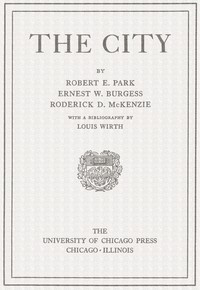
The city — Edition Insights
(0 User reviews)
651
Project Gutenberg
2024
Not confirmed
Sociology; Social psychology; Cities and towns; Sociology, Urban
Readers of public-domain and historical texts
Project Gutenberg digital edition
en
Edition facts
Words
79,152
Reading time
345 min
Text sections
19
Before opening The city — Edition Insights, the edition data offers a quick orientation: 79,152 words, 5 hr 45 min estimated reading time, and 19 detected text sections.
The text analysis averages about 16.9 words per sentence, while the detected sections provide another way to judge how the source is divided.
Project Gutenberg metadata also associates the work with “Sociology,” connecting these edition facts with the source record’s subject description.
Source:
Project Gutenberg record #73285
An editorial note on the language and narrative voice in Park, Burgess, and McKenzie's 1925 sociological study of urban life, noting shifts from programmatic preface to ecological metaphor and comparative analysis of primitive mentality.
Read the complete public-domain text at its original source.
Read on Project GutenbergThe preface to The City establishes a programmatic tone: the volume is framed as a “general introduction to further studies,” with each chapter arising as a “commentary upon and interpretation” of larger monographic research. The authors present themselves as explorers delimiting a field, and the prose is measured, institutional—fitting a University of Chicago Press publication from 1925. Yet as the text moves from preface into the body, the voice shifts markedly. Park’s opening chapter, originally published in 1915, retains a confident, almost manifesto-like cadence, while Burgess’s “The Growth of the City” introduces a more schematic, diagrammatic language of zones and expansion. McKenzie’s ecological approach, added later, brings a comparative, biological vocabulary. The result is a work whose internal voices do not fully harmonize, revealing the collaborative, evolving nature of the Chicago school’s early urban sociology.
From Program to Metaphor: The Shifting Register of the Preface and Park’s Chapter
The preface speaks in the collective first person—“we were asked,” “it has seemed”—and uses verbs of planning and delimitation: “outline,” “exploring,” “delimiting.” This administrative register gives way abruptly in Park’s chapter to a more declarative, almost literary style. He writes of the city as a “moral organization” and a “state of mind,” phrases that echo the earlier sociological tradition of Simmel but also carry a rhetorical weight absent from the preface. The shift is not merely topical but tonal: where the preface is cautious, Park’s chapter is expansive, even sweeping. He invokes “the city” as an entity with agency, a “living organism” that “selects” and “segregates” its population. This metaphorical leap—from administrative outline to organic metaphor—marks a distinct change in narrative pace, from measured exposition to bold assertion.
Burgess’s Zonal Diagrams and the Language of Natural Science
Burgess’s contribution, “The Growth of the City,” introduces a different register: the language of cartography and ecology. He speaks of “zones,” “expansion,” and “succession,” terms borrowed from plant ecology and geology. The prose becomes more technical, with sentences like “The typical process of the expansion of the city may be represented by a series of concentric circles.” This is a shift from Park’s moral vocabulary to a quasi-biological one. The pace slows: where Park generalizes, Burgess diagrams. He enumerates zones—the loop, the zone of transition, the zone of workingmen’s homes—and describes their characteristics with a taxonomist’s precision. The effect is to make the city seem less a moral entity and more a natural phenomenon subject to laws. Yet the language remains accessible, avoiding the jargon of later social science. The shift in voice here is from the prophetic to the pedagogical.
McKenzie’s Ecological Approach and the Comparative Turn
McKenzie’s chapter, the latest in composition (1925), pushes the ecological metaphor further. He explicitly compares human communities to plant and animal communities, using terms like “symbiosis,” “dominance,” and “invasion.” The prose is more abstract and theoretical than either Park’s or Burgess’s, with longer sentences and a greater reliance on analogy. A notable passage discusses “primitive mentality” via Lévy-Bruhl, contrasting “pre-logical” thought with rational, scientific thinking. This digression into comparative anthropology marks a significant shift in pace and scope: the text moves from the specific geography of Chicago to a general theory of mentalities. The voice becomes that of a synthesizer, drawing on multiple disciplines. The result is a chapter that feels less grounded in empirical observation than the others, more speculative. The collaborative volume thus presents not a single narrative voice but a spectrum, from the programmatic to the metaphorical, the taxonomic to the comparative.
Readers approaching The City will benefit from attending to these shifts in voice and pace. The preface sets expectations of a unified project, but the chapters that follow diverge in style and method. Park’s rhetorical sweep, Burgess’s diagrammatic clarity, and McKenzie’s ecological theorizing each offer a different lens on urban life. Rather than seeking a single argument, the reader might treat the volume as a conversation among three scholars, each refining a distinct vocabulary for the nascent field of urban sociology. The changes in pace—from measured outline to bold metaphor to technical taxonomy—mirror the discipline’s own evolution in the 1920s.
I keep returning to that old Chicago volume, how its ecological metaphors softened the rigid city into something breathing. It reminds me of a quieter kinship with those 1912 eugenics abstracts — both texts speak in measured tones about human patterns, yet one leans toward hope while the other, I fear, toward control. Their shared vocabulary of order still murmurs between my shelves. Abstracts of Papers Read at the First International Eugenics Congress University of London, July, 1912 — A Reader’s Guide feels like an old, uncomfortable acquaintance. Some conversations never quite end.
There are no reviews for this eBook.
There are no comments for this eBook.
Reader reflection
Your personal reading reflection
Build a private reading journal entry for this title.
Your progress
0
/
10
2
Was reading this book enjoyable?
3
Would you encourage someone else to read it?
4
How easy was the book to follow?
5
Did it raise ideas you would like to talk about?
6
How understandable was the text?
7
How would you rate its originality?
8
What did you think about the pace?
9
What changed or sharpened your thinking?
10