1

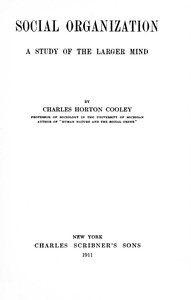
Social organization — Reading Companion
(0 User reviews)
577
Project Gutenberg
2024
Not confirmed
Sociology; Social psychology
Readers of public-domain and historical texts
Project Gutenberg digital edition
en
Edition facts
Words
114,342
Reading time
498 min
Text sections
43
The catalog record for Social organization — Reading Companion provides practical reading context through 114,342 words, 8 hr 18 min estimated reading time, and 43 detected text sections.
The text analysis averages about 26.4 words per sentence, while the detected sections provide another way to judge how the source is divided.
Project Gutenberg metadata also associates the work with “Sociology,” connecting these edition facts with the source record’s subject description.
Source:
Project Gutenberg record #72636
Cooley's 1909 study examines how individual minds form a 'larger mind' through primary groups, communication, and institutions. The opening chapters establish an organic view of society, while later sections analyze caste, class, and assimilation using historical and contemporary examples.
Read the complete public-domain text at its original source.
Read on Project GutenbergCooley opens Social Organization by insisting that human life is 'all one human whole' and that cutting it up for study kills it. This organic premise shapes the entire work: society is not a collection of separate individuals but a mental unity, a 'larger mind' that exists through communication and shared consciousness. The preface frames the book as a companion to his earlier Human Nature and the Social Order, shifting focus from the individual's social nature to the enlargement and diversification of intercourse. Early chapters introduce primary groups—family, playground, neighborhood—as the nurseries of human nature, where ideals of loyalty, truth, and kindness first take root. Cooley argues that these face-to-face associations are fundamental to moral development and persist even as society grows more complex.
The Organic View of Mind and Society
Cooley's first two chapters reject any sharp division between individual and social mind. He writes that 'mind is an organic whole' and that self-consciousness does not come first; rather, we become aware of ourselves through others. This 'larger introspection' treats society as a mental phenomenon, not a material one. Cooley acknowledges the importance of material conditions but deliberately focuses on the mental side. He argues that reform must be based on sympathy, not blame, and that responsibility is broadened, not lost, by this organic view. The moral value of a larger perspective lies in its call for knowledge: understanding social processes requires seeing them as interconnected wholes.
Primary Groups as the Nursery of Human Nature
Chapter III defines primary groups as those characterized by intimate face-to-face association and cooperation. Cooley identifies the family, the playground, and the neighborhood as typical examples. These groups are primary in the sense that they shape the individual's social nature and ideals. He argues that 'human nature' is not a fixed biological endowment but a product of these early associations. The ideals that emerge from primary groups—moral unity, loyalty, truth, service, kindness, lawfulness, freedom—form the basis for larger social organization. Cooley insists that these ideals persist even as society becomes more impersonal, and that they are essential for democracy and justice.
Caste, Class, and the Challenge of Assimilation
In later chapters, Cooley turns to the divisive forces that threaten organic unity. He examines caste as a product of race difference, conquest, and functional differentiation. Using historical examples—Germanic tribes, Roman traditions, American immigration—he shows how caste arises from hostile traditions and the inheritance of rank. He notes that peaceful migration of kindred settlers, like English immigrants to the United States, creates no class divisions, but that more divergent groups (Italians, Slavs, Jews) introduce racial and cultural distinctions. Cooley argues that assimilation depends on the character of institutions: some societies are 'rigid and repellent,' while others, like the United States, are 'almost ideally constituted to invite and hasten assimilation.' He concludes that divergent races can unite in common service of ideals like kindness and fair play, with the dominant group bearing chief responsibility.
The Larger Mind and the Reader's Path
The excerpts reveal a work that moves from abstract principles to concrete social analysis. Cooley's prose is measured and argumentative, building his case through repeated contrasts: organic versus mechanical, primary versus secondary, sympathetic versus hostile. Readers should note how he uses historical and contemporary examples—from Lombard laws to American immigration—to ground his theoretical claims. The book's structure is cumulative: early chapters establish the organic framework, middle chapters explore primary groups and ideals, and later chapters apply these concepts to problems of caste, class, and social differentiation. Cooley does not offer simple solutions but insists on the need for knowledge, sympathy, and a 'right spirit' in addressing social divisions.
Cooley's Social Organization rewards readers who follow his argument from first principles to applied analysis. The opening chapters demand careful attention to his organic metaphor, which shapes everything that follows. Later sections on caste and assimilation show how the same framework can illuminate persistent social problems. Readers should watch for Cooley's characteristic move: grounding abstract ideals in concrete social processes, and insisting that the larger mind is not a distant abstraction but something we participate in every day.
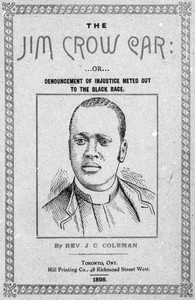
There’s something tender in Cooley’s old idea that we carry our earliest circles inside us, a “larger mind” built from voices we’ve known. Reading him, I kept thinking how that mind can also be a courtroom, judging some bodies unworthy of belonging. The Jim Crow Car; Or, Denouncement of injustice meted out to the black race — Key Ideas to Explore holds that harsh verdict, and I found myself setting the two books side by side, quietly.
There are no reviews for this eBook.
There are no comments for this eBook.
Reader reflection
How did this book work for you?
Your answers remain private and are stored only in this browser.
Your progress
0
/
10
2
How did the book work for you overall?
3
Would you encourage someone else to read it?
4
How demanding did the text feel?
5
Could you follow the author’s main argument?
6
How original did the book feel?
7
Would you like to discuss this book with someone?
8
Did the book meet your expectations?
9
In one sentence, what did you learn?
10