1

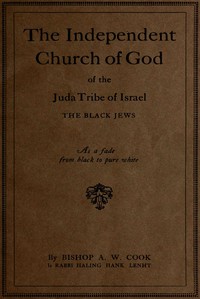
The Independent Church of God of the Juda Tribe of Israel: The Black Jews As a fade from black to pure white — Themes and Context
(0 User reviews)
94
Project Gutenberg
2022
Not confirmed
African Americans -- Colonization -- Africa; Southern States -- Race relations; Black Hebrews
Readers of public-domain and historical texts
Project Gutenberg digital edition
en
Edition facts
Words
23,700
Reading time
104 min
Text sections
20
The catalog record for The Independent Church of God of the Juda Tribe of Israel: The Black Jews As a fade from black to pure white — Themes and Context provides practical reading context through 23,700 words, 1 hr 44 min estimated reading time, and 20 detected text sections.
The text analysis averages about 22.5 words per sentence, while the detected sections provide another way to judge how the source is divided.
Project Gutenberg metadata also associates the work with “African Americans -- Colonization -- Africa,” connecting these edition facts with the source record’s subject description.
Source:
Project Gutenberg record #68729
This 1925 work by Bishop A. W. Cook combines religious charter, autobiographical sketch, and racial polemic, arguing for Black Jewish identity and African colonization. The excerpts reveal a blend of biblical interpretation, legal documentation, and political advocacy, with contributions from former North Carolina Supreme Court judge Robert W. Winston.
Read the complete public-domain text at its original source.
Read on Project GutenbergThe Independent Church of God of the Juda Tribe of Israel opens with a formal charter from the State of New York, establishing the organization legally before any theological argument. This bureaucratic framing sets the tone for a work that moves between ecclesiastical authority, racial advocacy, and personal testimony. Bishop A. W. Cook, also styling himself Rabbi Haling Hank Lenht, claims divine inspiration for his writing, which he asserts is the first of its kind in two thousand years.
The catalog subjects—African American colonization, Southern race relations, and Black Hebrews—are all present, but the excerpts show a more complex interplay. Cook’s text includes a lengthy contribution by Robert W. Winston, a former judge, who argues for government-sponsored African colonization, citing Liberia’s potential and criticizing U.S. policy. This inclusion of a white Southern legal figure complicates the book’s racial and political stance.
Charter and Constitution as Theological Foundation
The book’s opening pages reproduce the certificate of incorporation for “The Independent Church of God of the Juda Tribe of Israel: The Black Jews,” filed in New York. This legal document is not merely prefatory; it functions as a founding text, establishing the church’s official status before any scriptural exegesis. Cook’s subtitle, “As a fade from black to pure white,” appears only in the title and is not elaborated in the excerpts, leaving its meaning ambiguous. The charter’s inclusion suggests that Cook saw legal recognition as essential to his religious mission, blending spiritual authority with civic legitimacy.
The constitution that follows likely outlines governance and doctrine, but the excerpts do not provide its full text. Instead, the reader encounters a list of chapter headings that hint at the book’s range: “Black Moon,” “Negro Is Yet A Slave,” “Down on the Farm,” and “Defending the Honorable and Graceful Movements of Dancing.” These topics suggest a work that moves from racial critique to social commentary, all under the umbrella of Cook’s church.
Robert W. Winston’s Colonization Argument
Nearly half of the excerpted material consists of a sustained argument by Robert W. Winston, a former North Carolina Supreme Court judge. Winston advocates for the U.S. government to sponsor African colonization, framing it as a solution to the “race problem.” He dismisses the idea that colonization has failed, asserting that Liberia “has never been given a trial.” He calls for a new Goethals to make Liberia “as healthy as Panama” and criticizes the U.S. for reneging on a $5,000,000 loan promised by Presidents Wilson and Harding.
Winston’s rhetoric is striking in its directness: “Were I a negro,” he writes, “I would cease to fight against white prejudice, but raising the banner of ‘Pan-Africa,’ I would herald that ‘Unity of the Colored Races.’” He also claims that the only good of the Ku Klux Klan is to “frighten negroes from Southern States to other sections.” This inclusion of a white Southern judge’s voice within a Black religious text raises questions about the book’s intended audience and the nature of Cook’s collaboration with Winston.
The Book’s Self-Presentation and Audience
Cook’s work is marketed as a fundraising tool: “This book will be sold for one dollar to help finance the work of uplifting fallen humanity.” The back matter includes an appeal to “tell your neighbors to purchase a book,” indicating a grassroots distribution strategy. The author’s dual title—Bishop A. W. Cook is Rabbi Haling Hank Lenht—suggests a syncretic identity, blending Christian and Jewish traditions. The book’s claim to be “the first that has ever been published in this country or any other country, of this kind, for two thousand years” positions it as a revelation, though the excerpts do not substantiate this assertion.
The catalog subject “Black Hebrews” is directly relevant, but the excerpts show that the book also engages with contemporary political debates, such as Marcus Garvey’s treatment (“The Unjust Treatment to Garvey”) and the question “Will the Black Man Go Back to Africa?” The work thus functions as both a religious constitution and a political pamphlet, addressing a readership concerned with racial identity and emigration.
Readers approaching this text should be aware that the excerpts represent only a fraction of the whole, and the full work likely contains more autobiographical and doctrinal material. The collaboration with Robert W. Winston adds a layer of complexity, as his views may not align perfectly with Cook’s. The book’s hybrid nature—part charter, part sermon, part political essay—defies easy categorization. Pay attention to how Cook uses legal and biblical language to construct authority, and consider the implications of a Black religious leader publishing a work that includes a white judge’s colonization proposal.
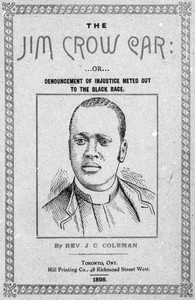
There are moments in the old Cook text—that strange faith, those legal arguments for a homeland—that feel like a hand reaching from another century. It makes me think of another relic I keep returning to, the quiet fury of Winston’s account of the Jim Crow car. Both hold a sorrowful hope, a belief in justice that the world refused to honor. The Jim Crow Car; Or, Denouncement of injustice meted out to the black race — Key Ideas to Explore sits beside it on my shelf, a pair of whispered testimonies.
There are no reviews for this eBook.
There are no comments for this eBook.
Reader reflection
How did this book work for you?
Your answers remain private and are stored only in this browser.
Your progress
0
/
10
2
Was reading this book enjoyable?
3
Is this a title you would suggest to others?
4
How much effort did this book require?
5
Did the book deliver what you hoped for?
6
How useful did the reading feel?
7
Is this a title worth rereading?
8
How closely did the book connect with your experience?
9
Which lesson or insight stayed with you?
10